

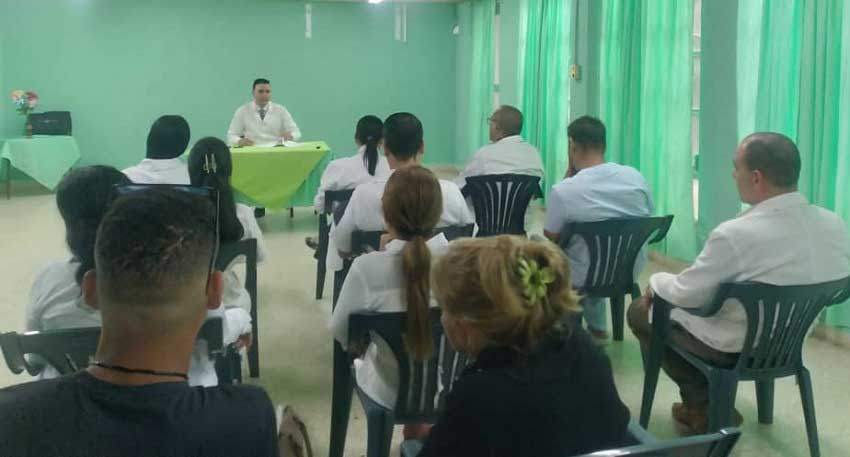
The Doctor Ernesto Guevara de la Serna General Teaching Hospital is the headquarters of an “Intervention Strategy for Combating and Controlling Drug Abuse in Las Tunas,” a pioneering initiative that brings together five entities, with the Provincial Psychiatric Hospital, the University of Medical Sciences, the Gustavo Alderaguía Polyclinic (as a pilot in primary care), provincial media, and the tourism sector, with the aim not only of curing but also of preventing through science and community involvement.
Las Tunas, Cuba.- For Dr. Alejandro Mestre Barroso, a specialist in toxicology, the challenge goes beyond immediate detoxification. The project also analyzes preconception risk and drug abuse.
"We have had cases of pregnant women who use drugs, and how can we prevent this if not from the preconception stage? These pregnant women are at risk because they are smokers, and because they live in areas prone to drug use. How can we focus on preconception risk so that they come to us for secondary care, to the obstetrics department, to avoid being as far off track as possible?”
"This is done first by characterizing the population and second by designing a strategy for women of childbearing age, especially adolescents. Characterize consumption in the preconception stage by implementing a maternal-child program survey.”
“We believe it is important to train every doctor or nurse at the polyclinic to determine, understanding, and above all finding those biases that allow us to identify in time the possibility that we have a teenager or a pregnant woman in the preconception risk stage who may be using drugs of abuse or who may be prone to drug abuse, and thus avoid situations such as the one we are currently dealing with.”
The doctor warns about the addict's paradox, which is that the longer they go without using, the greater the chances of relapse.
"We see this because, as time passes since the detoxification consultation, the patient tries to reintegrate into society; there are no therapeutic follow-up mechanisms, such as an institutional support network with the family. It must be remembered that once a patient is addicted, they will be for the rest of their life.”
The importance of this project lies in drug abuse prevention, which is why third and fourth-year medical and clinical bioanalysis students will be involved.
GENDER-BASED VIOLENCE AND PREGNANCY
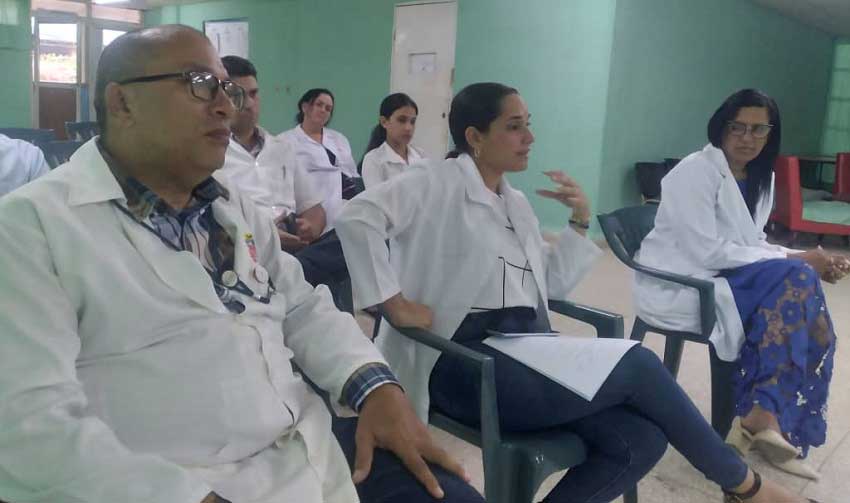
The strategy has a gender focus that is novel in the province. Dr. Elianis Gómez Velásquez, a second-degree specialist in legal medicine and researcher on the project, asserts that primary care is important for citizens.
"We are going to defend issues related to gender-based violence from our specialty and from what we have seen in terms of the increase in cases of gender-based violence.”
"By joining the project, we have found that drug abuse leads to violence, both as perpetrators and victims, and especially against women.”
"We have also seen cases where violence is associated with males, minors, and domestic violence. We want to continue with all of this through the project itself, also taking into account that it is part of my doctoral study."
The deputy director of Diagnostic Media at Guevara Hospital emphasizes the benefits of linking with specialties such as psychiatry and psychology, because drug abuse is a health problem.
“We must be realistic and say what is happening in this regard. As a hospital, we cannot act as if we are not involved because, as the province's top secondary care facility, we will receive all these victims. We are already seeing them in the Toxicology clinic that was opened in the Department of Legal Medicine.”
This association complies with the government plans and strategies of the National Assembly of People's Power. One of the fundamental pillars concerns the way to modify the treatment strategy in the current situation, not for prevention, but for patients who are already addicted.
Another crucial area is maternal and child health. The project analyzes preconception risk, a key stage in preventing irreversible damage. The research also seeks to characterize consumption in women of childbearing age, especially adolescents, to intervene before conception.
Dr. Rabiel Cárdenas Peña, head of the Teaching and Research Department at “Guevara” Hospital, emphasizes the vulnerability of pregnant women. "We must take into account the impact that all the effects of these substances have on the maternal-fetal process. These types of drugs, being synthetic, structurally modify substances, and we do not know all the medical and psychological aspects that may arise, which requires us to update care protocols day to day."
Prevention is the backbone of the strategy, and third- and fourth-year medical and clinical bioanalysis students have been involved in this effort.
Dr. Marianela Zapata Romero, director general of Guevara Hospital and member of the Cuban Parliament, praises the impact of this scientific association. “The country demands that science transform the population’s health status, as the president asks of us, and that is what this strategy is all about. Today, it is a social problem with an impact on Cuban youth.”
From the clinics of the province's largest health institution to family doctors' offices, a network of science and humanism is being woven throughout the province to combat the scourge of drugs.