

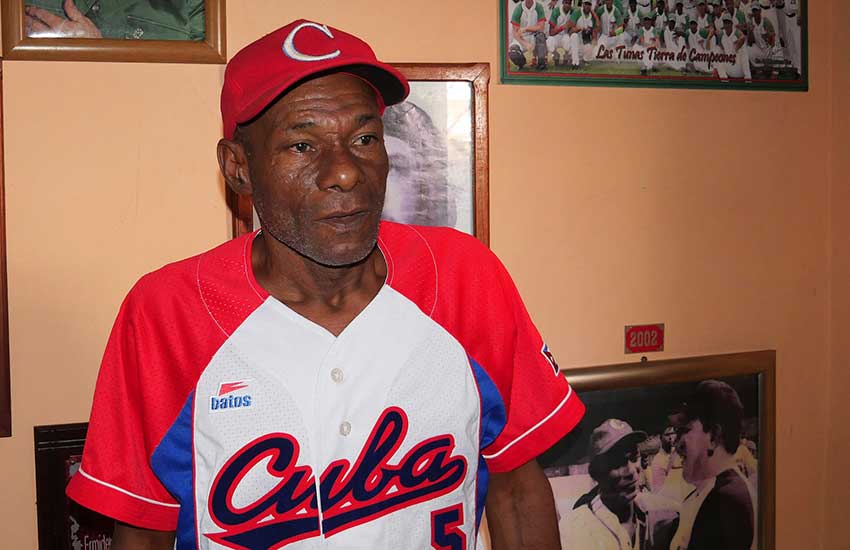
Since colonial times, Macagua was known because a ragged Jamaican man with long hair and a wild lifestyle lived alone in the caves of its hills, appearing from time to time. This is the legend of “Pelú” of Macagua.
But in the 1960s, a patriarch emerged there: Domingo Urrutia Estrada, Cuba's most outstanding sugarcane cutter, eight-time national harvest hero and National Hero of Labor; father of Ermidelio, grandfather of Henri, and uncle of Osmany Urrutia.
In that same place, Ermidelio began playing at the age of 7 with a piece of rubber from his uncle Giraldo's truck tire, which he rolled up with the same thread from the tire and hit with marabou bats made by Haitians living in the area.
It was also there that he first felt that his physique was a handicap, because one day Giraldo himself scolded a group of neighborhood boys for letting such a small child play. That child was Ermidelio.
“But in that friendly game, I hit a ball so far that they're still looking for it in a cane field. That's when my uncle smiled and let me keep playing,” recalls Ermidelio, now 62.
“I owe a lot to Macagua 8,” he acknowledges, "because I didn't have the opportunity to be on the so-called development ladder: school-youth-adults.
I asked him if I had heard correctly that he had also dabbled in boxing as a teenager, and he replied immediately, “Yes, that was in the community of Bartle.”
“And why didn't you continue with boxing? Did they beat you up?” “No (he laughs), I didn't get anywhere, but I learned.”
Ermidelio pauses to remember his father, from whom he inherited his strong sense of responsibility, tough character, and sober greetings.
"My first official baseball championship was in the 1980 Workers' Games; then I continued in the Sugar League with the Antonio Guiteras team, which represented Las Tunas, and then I was in the second division of my municipality."
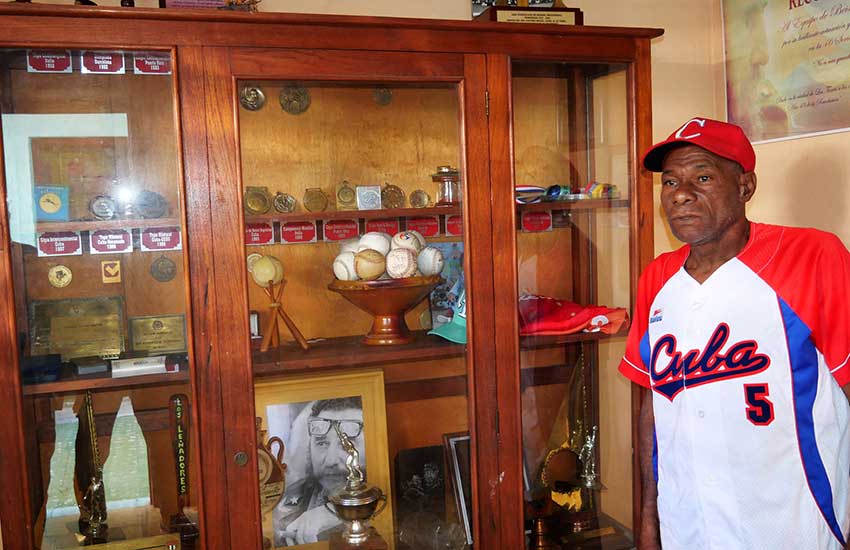
"In those events, I played second base and shortstop, but when I joined the Las Tunas provincial team in 1981, the only way I could play was as an outfielder, because those positions were occupied by established players such as Roberto Lemus and Alexis Griffin."
"Pipo Tejeda (now deceased), whom I consider an extraordinary coach because of his high standards and methods, said to me during a training session: ‘Get ready to catch 100 fly balls. So I replied: ‘But, Pipo, that's a lot’, and he retorted: ‘Now you have 101’."
"Then I injured my right arm and shoulder. And when I thought I wouldn't be able to train because of the injury, Pipo immobilized my arm with a brace and had me field with my left hand in a glove. That was decisive in my decision to specialize a little in catching fly balls ‘on a platter’."
"I had a hard time making the national team, until Bobby Salamanca knocked three times on the radio booth during a Radio Rebelde broadcast and said, 'Look at the black kid from Las Tunas, he's knocking on the doors of the Cuban team."
"That opinion was very important in finally getting me included on the roster; although, once on the team, I never started playing, and when I came out to bat as a pinch hitter, I responded, but in the next game, I was back on the bench."
“Once, I was walking from one place to another outside the dugout with a bat in my hand, and a manager asked me, ‘Are you nervous, or what's going on?’, and I said, ‘Yes, I'm nervous because they won't let me play'.”
Ermidelio puts Víctor Mesa on a pedestal. He is, as we Cubans say, a good person and a human being. “He was the only one who defended me in all the stands; he said I was small, but I hit the ball with tremendous force.”
In his home in the capital of Las Tunas, where he keeps all his trophies, medals, and awards in what he calls “my museum,” he points out in great detail the value of each award, including photos of leaders Fidel and Raúl Castro.
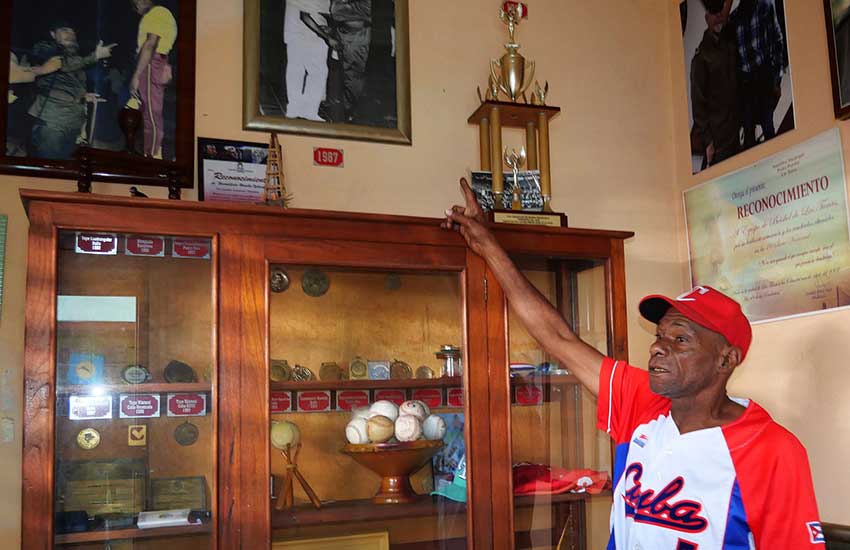
The display cases that fill a room in his home are a reminder of the laurels he won at the 1992 Olympic Games in Barcelona, the world championships in Parma, Italy (1988); Edmonton, Canada (1990), and Nicaragua (1994), as well as the Pan American Games in Havana (1991) and Mar del Plata (1995).
In 16 national series, Ermidelio compiled a batting average of .310, 221 home runs, 865 runs batted in, and 180 stolen bases, with a powerful arm and accurate throws from the outfield. He is the epitome of what is known as a “five-tool player.”
And when it comes to records, he set several: in the 1994 Intercontinental Cup, with a batting average of .667; home run leader in the 1990 and 1991 national series, with 20 and 16, respectively; and in 1992, first in walks received, with 26. In 1982, he was in contention for the batting title.
It was not a matter of discriminating against a country boy from Jobabo. In the end, it was recognized that it was almost impossible to believe that with a slight physique—5'6" tall and weighing 137 pounds—he could have so much strength and hit such long balls.
Already excluded from the national team, he and other teammates went to Japan to play for different teams in that league. And when a Cuban pre-selection team arrived to play exhibition games, the “Lumberjack” from Las Tunas hit six hits with tremendous power.
And at the end of the game, he says, several Japanese players approached him. They said things in their language that, of course, he couldn't understand, but they touched his arms (long, powerful arms that had nothing to do with the rest of his physique) curiously, as if exploring (he laughs) to see what “material” they were made of.
Now, Ermidelio says that after his retirement in 1996, outstanding baseball players such as current Major League player Yordan Álvarez, brothers Yosvany and Yordanis Alarcón, and Yunieski Larduet passed through his hands as a coach, both at the School of Sports Initiation (EIDE in Spanish) and at the Academy. He recalls that the Leñadores qualified for the national series for the first time when he made his debut as manager.
Proud to have represented Cuba in multiple championships, Ermidelio always believed in himself. He does not consider himself gifted, but he believes he could have participated more in the events he attended.
Those who believed in him saw him as Don Quixote or the biblical David, but never as Jeremiah (the so-called “weeping prophet”). “I felt discrimination because of my physique,” he confesses, “but I always said that everything depended on me, that I didn't measure myself from head to toe, but from head to sky.”
But his big chance came in August 1991, at the Pan American Games in Havana, in a packed Latinoamericano stadium, in the final against Puerto Rico. It was a fabulous day: he went six-for-six, with two doubles and three home runs, one for each corner of the outfield.
It was a spectacular moment for Ermidelio: the number one fan, Commander-in-Chief Fidel Castro, brought him down from the podium to hug him and ask him, “Where do you get so much strength?” Orestes Kindelán, who was nearby, replied, “Commander, he hits with his heart.”
And Ermidelio summed it up this way: “Commander, the problem is not hitting the ball, but hitting it well.” (ACN)