

Under the mosquito net, a crackling of bones reveals María Isabel. Her right ankle is like a shackle that keeps her pinned to the wooden bed, unable to get up. Real pain has also crept between her ribs and hands, and she thinks she lost the use of her neck about 17 days ago, when fevers forced her to hide under the tulle mesh so as not to infect more mosquitoes.
From her makeshift shelter, she shows the swelling in her upper limbs, which “gets better for a few days, but then comes back stronger,” leaving her “exhausted.” With shining eyes, she recounts her other realities, which are just as painful: she doesn't have enough money in her checkbook to buy paracetamol, let alone to guarantee real protein to boost her diet. In her condition, she is also unable to clean houses and earn a little extra income.
Gloria, 74, makes her way as best she can to the Manuel (Piti) Fajardo polyclinic in this city in search of relief. She believes she contracted Chikungunya more than two months ago, but she is still swollen and in as much pain as if only a couple of hours had passed since her infection. At her side, her husband Rolando is in even worse shape. As a result of the discomfort, he suffered a fall, and now, with a broken shoulder, he does not know how to endure so much pain.
Joseíto asks us to turn off the microphone, although Julia, his life partner, insists that we do not. The octogenarian does not want to talk to anyone... Julia is scared because about a week ago, she heard him repeat that he is no longer useful, that he wants to live. When arboviruses began to wreak havoc, they took precautions: they dusted off the mosquito net, took out their long pajamas, but even so, they fell ill.
Julia recovered quickly, but “the old man can't take more than three steps, he can't take the little walks he used to take around the neighborhood, all he does is listen to the ball.” Joseito's bowed knee deformities require treatment. They went to the doctor once, but they can't afford to pay for transportation to the hospital several times a week.
...
Following the long saga of pain that has colored the landscape in Las Tunas in recent months and seems to have no end in sight, health services in Las Tunas are rethinking new ways of operating. Chikungunya has shown that, right now, new ways of operating are needed to bring help closer to communities.
Ariel Guevara Bringa, general director of health in the province, is no stranger to this reality: "As part of the care provided to patients with arboviruses, especially chikungunya, rehabilitation measures and comprehensive care for convalescents have been incorporated into the protocol for action in the chronic phase.
"In the case of the province, on the recommendation of the Ministry and in line with the characteristics of each community, we have decided to initiate consultations for convalescent care through family medical clinics. In each health area, with basic work teams, patients will be evaluated.
"It is written that after the third month of convalescence, the chronic stage begins, but in Las Tunas, we have established that early on, after 21 days of symptoms of joint pain and inflammation, patients can already go to the clinics to have their health status evaluated, and there, their referral to the health area will be decided."
"Once the family doctor has evaluated the patient and referred them to the rehabilitation ward of each polyclinic, where a commission made up of five doctors, including physiatrists, clinicians, pediatricians, specialists in natural and traditional medicine, and psychologists, has already been set up."
“This multidisciplinary team will be responsible for providing individualized care with various treatment options to alleviate the patients' health conditions. Therefore, we suggest that the population go to the medical clinics and take care of their future well-being.”
A BEACON OF HOPE
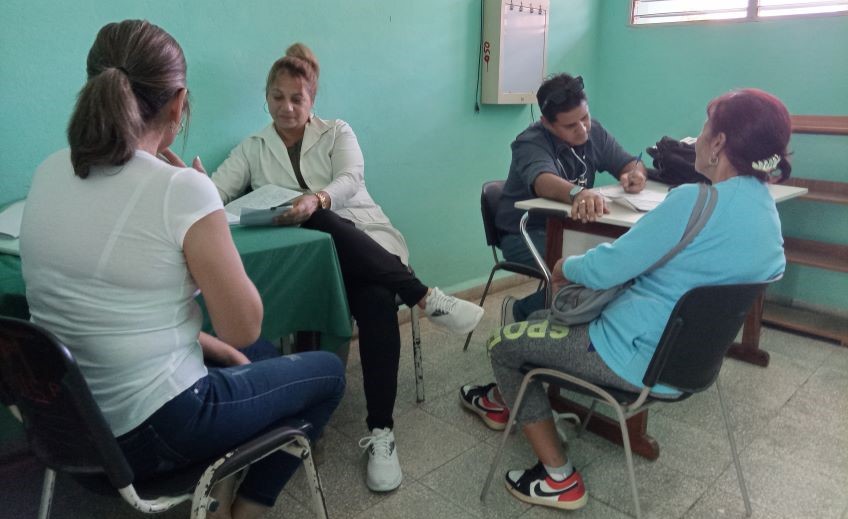
Outside the “Piti” rehabilitation clinic, the number of people who pass by every day is a measure of the scars left by the current arbovirus outbreak on the lives of the people of Las Tunas. Internal medicine specialist Dayron Echarte Camejo shares his daily routines with 26.
“The consultation began recently,” says the doctor. "Right now, I am conducting a comprehensive evaluation of patients by specialty. Here, we will treat the subacute stage of the disease, which lasts between 14 days and 3 months."
"The population has been exposed to several viruses in a short period of time. We are facing COVID-19, hepatitis, dengue, and Oropouche, and all these viral processes have resulted in patients having a fairly low immune level.
This, combined with a diet that is not the most appropriate, leaves the body with quite a few sequelae."
"People associate these consequences more with arthritis, but they are systemic, cellular. Therefore, our work will focus on reducing inflammation in the body. There are studies in the country with immunomodulators, but they are not yet being applied here."
“The treatments here will be with drugs and traditional medicine. We have combined our knowledge so that patients can experience improvement; we want them to come to the clinic, not self-medicate at home, as this is the best key to their recovery.”
ESSENTIAL SUPPORT
Dr. Alennys Más Pupo, in her capacity as a physiatrist, is very clear about the scope of her work in this specific context. "They arrive in a lot of pain. The care is personalized. We treat the inflammation first. Then, for example, if the patient is left with a limitation in the wrists, we apply heat and gentle exercises."
"What we see most are patients over fifty who are incapacitated. The most common sequelae are in the wrist and feet, and those patients who cry here get very depressed, hence the importance of having a psychologist here in the clinic."
"We are including exercises, infrared heat, massage, and the use of some physical agents such as lasers and magnets in specific cases in the consultation."
For her part, psychologist Yamile López Mulet is focusing on other sequelae that are not talked about much but are just as troublesome. Her focus is on people who arrive with noticeable signs of anxiety, depression, and those who suffer from insomnia and need emotional strength.
Under her radar are older adults who are unable to get up without help, comb their hair, button their clothes, or even pick up a spoon to bring it to their mouth. These are people who live alone and now cannot fend for themselves and see themselves as a burden on their family.
“As part of the multidisciplinary rehabilitation team, we provide supportive therapy and use the very effective floral therapy, as well as other individualized approaches. This disease causes insomnia, and it is important to reverse it so that patients can rest.”
...
Las Tunas, at this moment, is overshadowed by the painful shadow of Chikungunya. In the neighborhoods, it has been like a wave that no one can escape. It even returns to infect those who seemed immune. Its departure is still an unpredictable date. On its way, it also hits the shortage of medicines, the excessive price of basic foodstuffs, the energy crisis...
The list of sufferers is growing, and it is a reality. Medical services are preparing to alleviate ailments and reduce inflammation in the body. Going to the doctor's office now seems like the smartest decision and the first step in trying to face a virus that has unexpectedly scarred the lives of the people of Las Tunas.