

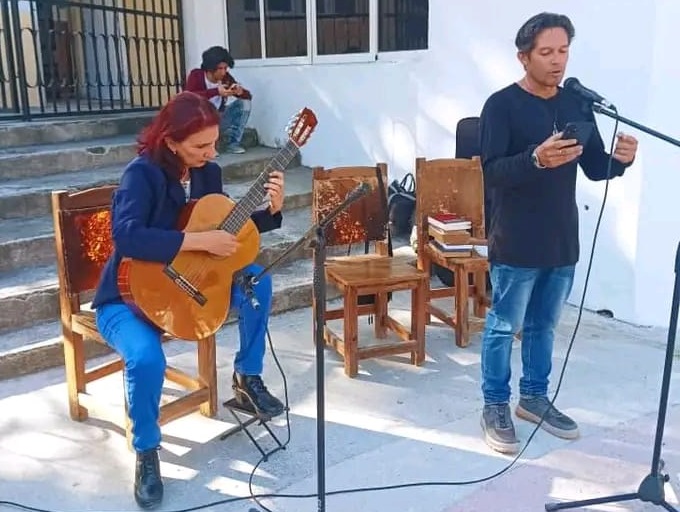
Every March 21st, International Poetry Day, exponents of this artistic expression share verses through various channels to honor the gift that inspires them to write. Among this effervescence of soulful poems is one by Yury García Fatela, writer, cultural promoter, coordinator of the El Cucalambé literary workshop, and director of the José Martí Plaza, among other roles.
Las Tunas, Cuba.– Hombre mirando al Ningueste (Man Looking at Nowhere) is a poem brimming with symbolism, inner emanations, critiques disguised as beauty, and much more. But above all, from the perspective of 26, it becomes a song for peace, a way of saying “enough” to the many evils that plague humanity today, especially, a “not to war.”
Although he is not the only author to have drawn inspiration from this topic, his composition resonates particularly strongly in light of current world events. "Man…" is dedicated to Sadako Sasaki, the Japanese girl who developed leukemia after the atomic bombing of Hiroshima, and to the girls of Iran, victims of the armed conflict of the United States and Israel against the Islamic Republic.
Now, with news like the double missile attack on the Minab primary school in Hormozgán province still fresh, a young man from Las Tunas —as others have done before— pours his grief into verse. He demonstrates something that those who inspire words know very well: poetry doesn't only speak of footlights and tinsel, but also —and above all— of pain, heartbreak, absence, emptiness…
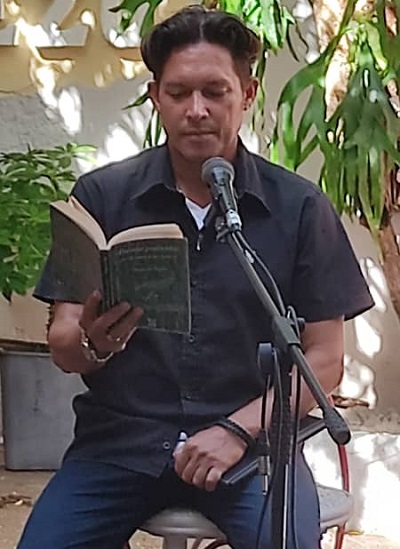 “Art is one of the most important intellectual weapons that can be used against war. The powerful often belittle a protest, a poster, or something similar; however, when an expression like art appears, where ideas are expressed with a level of refinement, lyricism, and forcefulness, from a poem to a song, for example, the message is sometimes much stronger.
“The songs of John Lennon, Picasso's painting Guernica, and César Vallejo's poetry collection España, aparta de mí este cáliz are proof of this… Art endures through time and keeps the denunciation relevant. Poetry is not just beauty and feeling; it has a social function; it touches you in your deepest self, in your shame, your ethics, and your sense of good, which is what peace truly is.”
Thus, with his work, Yury pays tribute to the young girls murdered in Iran and also to Sadako Sasaki, a Japanese girl who wished to be cured of an illness caused by radiation from an atomic bomb, a dream she planned to fulfill by folding a thousand paper cranes, in keeping with a legend from her country. She died without finishing them (her friends did), but since then, these origami “fruits” have become a symbol of peace throughout the world.
Now, as the arrival of the spring equinox and its tender way of embracing difference gift us with poems like Fatela's, may his verses serve to make us reflect on what more we can do for a better world.
MAN LOOKING AT NOWHERE
To Sadako Sasaki
And to the Girls of Iran
I am sitting on the curb of the world
like a flat-Earther facing the abyss
I feel the tangible edge of napalm-cotton
as I rock my feet over the Nothingness that devours Fantasia
I look at the diamond they use to frack the earth
and betray the last fossil diamond of Moby Dick
I look at the conventions that claim to date time
For an instant, I close my eyes and rest
But I must return to the furies of the market
to the migratory San Fermín
to the anorgasmic sexual torrent
Ideally, I wouldn't know
that I had never tasted the juices of the soul
I can still give my bread without flinching
melt the ship with a like
dry a stranger's bewildered eye
I look to the east
to the human traffickers with families
hurried for dinner
To those who spread the chain reaction and make their silence, and I turn away
I look to the South
to the false positives of the struggles for peace
to the officers who save missing grandchildren
and They teach them to say "daddy," and I turn away.
I look north
to the holy cleanliness of the natives
who didn't learn the Gospel
to the priests who bless the virginity of the altar boys, and I turn away.
I look west
to the gun-toting fever of the gold rush utopia
to the tender dedications of the soldiers
to Little Man and Fat Boy, and I turn away.
I look at the fish that learned to breathe through plastic
to the pale reefs petrified with fear
to the suicide squads of dolphins
to the cows stressed from walking in a straight line
to the boys who will be fathers right now
when they finish fornicating prematurely
to the girls who marry out of love for a distant neighbor
and cross the ocean altruistically to have their picture taken
with a reproduction of the Mona Lisa
to the doctors who interrupt life to save it.
I look at the epicenter where a girl waters
with origami cranes
the radioactive flowers
on the main building.