


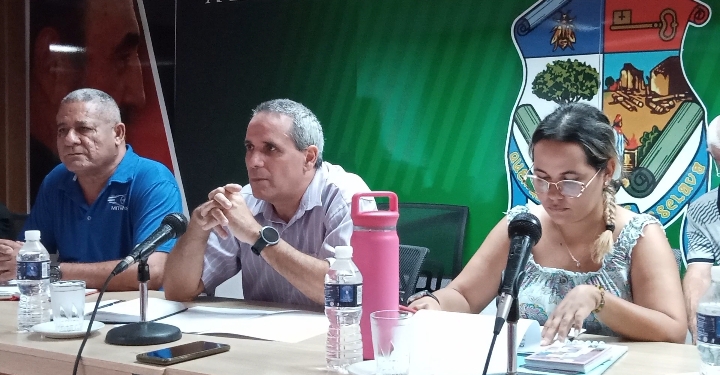
A team from the Ministry of Transportation, headed by Vice Minister Marcos Antonio Bermúdez de la Torre, made a working visit to the eastern province of Las Tunas to assess the progress and implementation of the 176 economic and social transformations the country is experiencing.
Las Tunas, Cuba.- During his tour, the manager was able to talk with directors and workers in the sector about current challenges, new management measures, and their impact on the population and the local economy.
The exchange is part of Thematic Axis 18, referring to Transformations in transportation. "As a Ministry, we are going to support and respect the decision regarding the structure of each territory. The analysis must be carried out with the greatest comprehensiveness so that the approved organization responds to municipal autonomy," said Bermúdez de la Torre.
One of the topics addressed was the situation of the port and revenue management. It was recognized that most of the perceived external benefits came from the right of docking. However, by decreasing this activity, the entity has managed to increase its profits through new forms of non-state management, exceeding 120 thousand dollars and adding millions of pesos in national currency. However, the intensification of the economic, commercial, and financial blockade imposed by the United States government continues to make it difficult for new ships to enter the port.
Faced with this panorama, sector executives indicated that letters of intent have already been signed with people inside and outside the country, and the new measures will allow the USD to be incorporated into the rates.
In the railway sector, local representatives explained that the entity has not managed to link itself with any economic actor in the non-state sector. Although local and intermunicipal trains began to circulate, it was recognized that it has not been possible to maintain the tracks as they should.
Even so, the financial results are not negative, since the entity reports four million pesos in profits, even when it was practically without work for nine months. The union maintains good acceptance by the population with the prices that are managed and actively works to seek linkages.
For its part, the Las Tunas Taxi Agency is positioned as one of the first companies in the sector to embrace the economic and social transformations implemented in the country. Together with Tec-Soluciones, they created the first solar-powered refueling station in the province. Currently, their biggest concern lies in the charging of electric cars, since they use energy from the national electrical system.
To mitigate this high consumption, the Vice Minister proposed to the provincial leadership the creation of charging points in hospitals, "which would guarantee the quality of service to hemodialysis patients and support public passenger transportation, always taking into account the charging capacity of these vehicles."
For their part, local authorities reaffirmed their interest in accompanying ongoing transformations. The capital of Las Tunas plays a fundamental role as a receiver and sender of transportation. In this sense, the support provided by the provincial management for the incorporation of 176 electric tricycles was highlighted, intended to guarantee passenger mobility. The immediate challenge for local authorities is to organize this service a little more, ensuring that the majority of drivers have their respective licenses.