


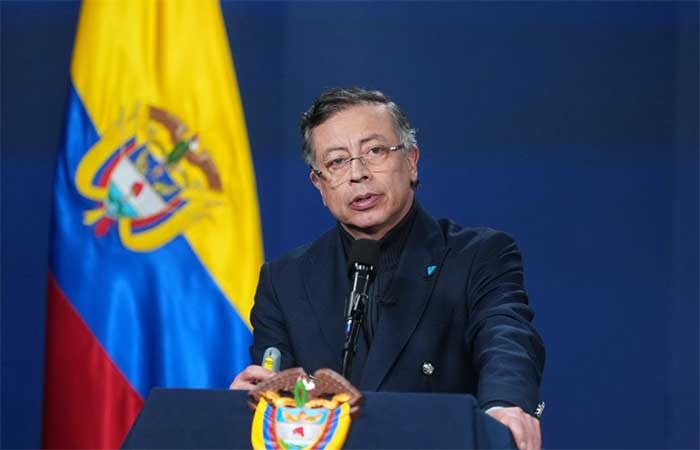
Colombian President Gustavo Petro assured this Monday that he has evidence of massive irregularities in the scrutiny of the June 21 presidential election, in which ultrarightist Abelardo de la Espriella was declared the winner.
"We have all the information about an IP server located in Los Angeles, California, owned by the Bautista brothers – owners of the company Thomas Greg & Sons, in charge of the pre-count and the logistics of the final count – integrated into the scrutiny operation, where algorithms that substantially varied the vote count in favor of Abelardo [de la Espriella] were used," the president stated on his X account.
According to him, "the algorithms that tainted the electoral result were used with the electoral census of those who never vote to be replaced by voters who could do so multiple times or without voters at homogeneous jury tables."
To illustrate his argument, he pointed to voting tables set up abroad, where De la Espriella "obtained 177,000 votes above [Iván] Cepeda," detecting the presence of jurors residing in Colombia and not "in the U.S. and Spain," which he called "illegal," as well as "voters taken to the soccer World Cup who could vote seven times at the polls under the names of those who never vote."
According to Petro, this 'modus operandi' was repeated within Colombian territory, specifically in "various regions" of the departments of Antioquia and Norte de Santander, as well as in areas of Medellín and Bogotá where political conservatism predominates. "That's why my son found that someone had already voted in his name," he asserted.
INTERFERENCE
The dignitary insisted on denouncing that the recently concluded electoral process was the object of foreign interference. He first pointed to "a private Israeli intelligence company named BlackCube," which he claims was responsible for supplying "biased algorithms and other support" to Thomas Greg & Sons.
He added accusations against Balart, a "lobbying" company "paid millions of dollars to clean Abelardo's [de la Espriella's] image" – which he described as "quite dirty" – and tasked with "convincing" U.S. President Donald Trump to publicly back the ultrarightist.
"During my phone conversation with Trump, I was able to verify that he did not know that I did not support De la Espriella due to his old ties with drug trafficking and genocide in Colombia. Hopefully, amid his concerns, he has time to call his intelligence bodies to tell him who Abelardo de la Espriella is, why he is a U.S. citizen, and who his partners are, including alias 'Boliche'," he stated.
'Boliche' is the nickname of Jorge Luis Hernández Villazón, a former Colombian drug trafficker and paramilitary who served as a DEA and FBI informant for about 25 years, involved in extortion and money laundering schemes in the U.S. The previous week, candidate Iván Cepeda accused Hernández Villazón of having a "close link" with De la Espriella, who before entering politics worked as a defense attorney for figures linked to paramilitarism.
"ELECTORAL FRAUDE"
On these allegations, Petro stated: "The current president of Colombia is faced with evidence of electoral fraud through algorithmic means and with foreign financing, prohibited in our Constitution." He asserted that what happened has been "the hardest blow to national sovereignty since the Spanish reconquest in the years of the 'Patria Boba'."
"The cybersecurity systems of the Registraduría, which should have detected the entry of algorithms and the manipulation of E14 forms from abroad, belong to private U.S. or Israeli companies," he considered.
He concluded that the Registraduría, the entity in charge of directing electoral processes in the South American country, "clumsily or corruptly," handed over "the security of the vote of the people of Colombia to companies whose governments, which control them according to their national legislation." "They already had a candidate in Colombia. That's why there was no alarm," he added. (CubaSí)