


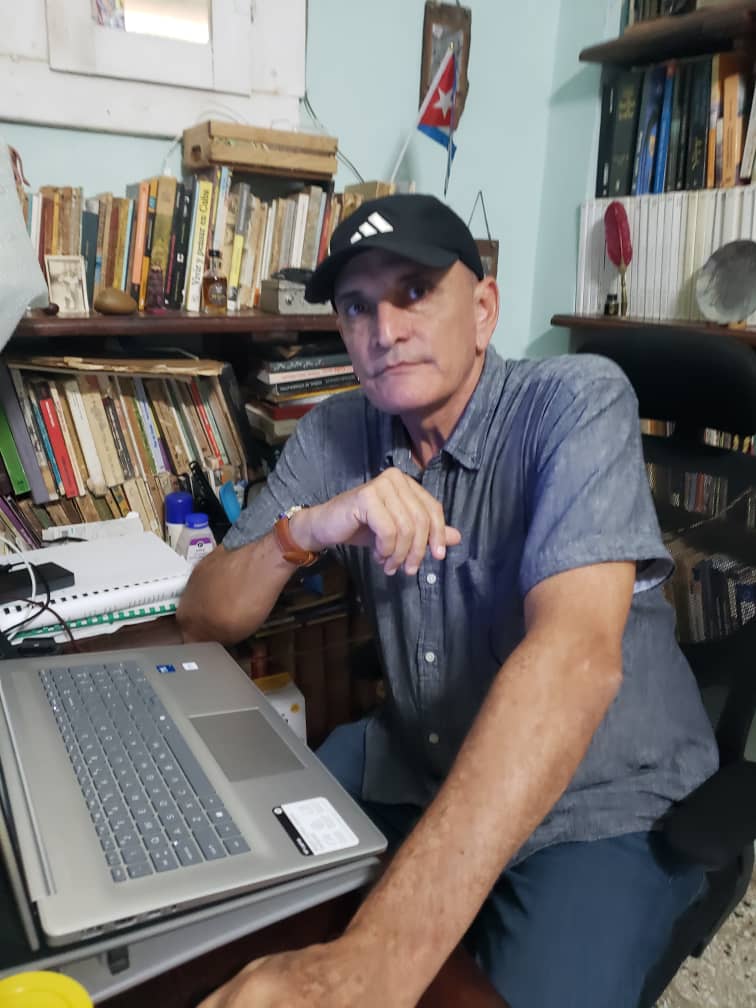
"Winning the Guillermo Vidal Award is a source of pride, but it also hurts; I would have preferred not to celebrate an award and for him to be alive. A few days ago, on his birthday, I told some friends that we would all be better if he were alive. I know he would continue writing, and we would be better writers and people," confessed Nelton Pérez Martínez, winner of the current edition of the national award named after the author of Matarile, to 26.
At the close of the literary event that each year pays tribute to the man who revolutionized 20th-century Cuban fiction, the results of the competition were announced, with young Enmanuel Aguilar Reynosa also receiving a mention for Quienes se tragan el ruido (Those Who Swallow the Noise).
In the case of El aprendiz, Nelton's novel, the jury —made up of prestigious writers Emerio Medina, Sergio Cevedo, and Alberto Marrero—awarded the prize after analyzing the 12 works in competition, because it is, among other things, "a historical novel with elements of fiction in which real characters interact with fictional characters, achieving a high degree of verisimilitude. This work accurately reflects the political and cultural atmosphere of the first half of the 19th century in colonial Cuba."
When asked about his creation, the author said: "El aprendiz is a novel that I wrote through the narrator, who is Cirilo Villaverde himself, who is about to die in New York. He was the apprentice of the Club de los Delmontinos; the young guajiro who came from Havana and was not among Domingo del Monte's favorites, but who worked hard and later managed to produce the main work of that entire group. He is someone who is reminiscing about his youth, everything that was experienced in Havana when they were trying to create a country through literature.
"The first version of Cecilia Valdés was different; then Villaverde matured as a narrator and brought his masterpiece to life. The apprentice plays a little with the recreation of that era, the friendship between Los Delmontinos and those close to them, the captains general, the situation in the country, the dreams... It's a novel that required research, something I enjoy very much, as I feel like I'm traveling back in time to eras where sometimes the answers that one cannot find today can be found. For me, the historical novel is a time machine."
Nelton, who had the good fortune to meet Guille, cannot help but mention him from time to time, knowing that his legacy must —against all odds— remain... "Guillermo Vidal, like Domingo del Monte, despite the differences in time and place, was someone who lent books to us younger people, reviewed our works, and this was also the case in Domingo's gatherings, where we even read the galley proofs of what was going to be published. Groups of writers always have points of contact, even as time passes; what changes is the perspective. Just as in Havana in 1830, in Las Tunas in 1993 and 1994, several Cuban writers gathered around Vidal, not just the ‘tunantes’, as he liked to call us...
"I especially remember when we traveled to La Cabaña, we would gather around him. That is something I miss and will always be grateful for; Guillermo—more than a teacher—was a friend and made us feel like equals. Thus, with immense humility, he would say things in your favor, point out where he believed you were wrong, but always with tremendous freedom. We were a group of writers who, around him, dreamed... The Apprentice, like all my work, owes him a great deal."
So, ever since he met Vidal in 1992 at an event held at the Casa de la Cultura in Manatí, he would be part of that “narrative team” that even today “remains real, sometimes whispering to you...” "At that time, his greeting was: ‘You remind me of Félix Luis Viera’ (a writer of Cuban origin), I think more because of his physical appearance. A month ago, I met this author in Miami and told him that I had been introduced to his work on Guillermo's recommendation. From his expression, I knew that he also missed him. And those are the things that tell you that he was a key that opened many doors for you.
"Another moment I treasure was when I won my first prize in a love story contest in 1993 with Las putas y el poeta (The Whores and the Poet). Guillermo was part of the jury. It made him and Garrido immensely happy. More than 60 pages of Matarile were written at the Las Caobas hotel in Manatí, as its author acknowledged.
"At that time, I didn't know him, but I remember that later I took that novel two or three times in manuscript form on the ‘Tren Guantanamero’ to Havana, where Manuel Mecías, another writer from Las Tunas who lived there, reviewed it. I brought it back, and Guillermo made his suggestions, and so on. On the train, I would look at the proposed changes, some of which I agreed with and others I didn't. That's why we were so happy when the work was published. The camaraderie that literature provides is something that cannot be compared; not even we, as writers, can describe it," he concluded.
...
Nelton, who has several unpublished books (including a trilogy of novels about the American colony that lived on Isla de Pinos from 1902 to 1981), tells 26 that he wants to dedicate El aprendiz to dear friends from the 1990s in Las Tunas: Carlos Esquivel, Alberto Garrido, Frank Castell, Osmany Oduardo, Ray Faxas...
His award, beyond demonstrating the obvious (talent, recognition, and mastery), also unravels the threads of death, to show that the legacy of a writer like Vidal is not only measured in published books or the occasional award; it is also measured by the perpetual knowledge he leaves behind in his “writing colleagues” (as María Liliana Celorrio calls her brothers in letters). That is why, right now, if we allow ourselves to dream, we can perhaps imagine Guillermo smiling proudly from some corner of blessed eternity.