


The Cuban energy sector is facing the most complex situation in recent decades as a direct consequence of the unprecedented intensification of the economic, commercial, and financial blockade imposed by the United States. Despite this, the fundamental objective has been to seek alternatives to minimize the impact and maintain production levels.
On the television program Mesa Redonda, the First Deputy Minister of the Ministry of Energy and Mines, Argelio Jesús Abad Vigoa, explained that until the end of last year, “despite a blockade that has been severe for more than six decades —with persecution of suppliers, sanctions against shipping companies, and financial difficulties”— Cuba was able to acquire fuel on the international market. “It wasn’t easy or cheap, but the ships arrived to sustain the economy, society, and the lives of the people.”
However, as a result of the implementation of the energy blockade, not a single ship carrying fuel contracted on the international market has entered the country for more than three months. “No diesel, fuel oil, gasoline, jet fuel, or liquefied petroleum gas has been received,” Abad Vigoa noted.
This situation has directly impacted electricity generation. As the deputy minister explained, there is more than 1,100 MW available in distributed generation and more than 330 MW in the Mariel and Moa engines that cannot be used due to a lack of crude oil. “In total, more than 1,400 MW of installed capacity remains out of operation.”
Currently, Abad Vigoa explained, power generation relies on domestic crude oil at thermoelectric plants, associated gas from oil wells at Energas facilities, and renewable energy sources (RES). “That is why the system becomes unstable, and power outages become prolonged and painful.”
MODEST PROGRESS IN PRODUCTION
Abad Vigoa noted that in 2025, the Cuban Petroleum Union (CUPET) reversed the downward trend in domestic crude oil production and reached the highest figure in the last seven years in oil equivalent, a trend that continues in the first months of 2026.
New wells have been drilled with positive results, increasing the production capacity of crude oil and natural gas.
In terms of power generation recovery, 348 MW of thermal generation capacity has been restored so far this year: 80 MW at Unit 1 of the Felton plant, 85 MW at Unit 2 of the Santa Cruz plant, 158 MW at Unit 4 of the Céspedes thermoelectric plant in Cienfuegos, and 25 MW at Guiteras.
At Unit 2 of the Felton thermoelectric plant, progress is being made on the assembly of structures and the manufacture of key components. Meanwhile, at the Antonio Guiteras plant, major maintenance work is being carried out.
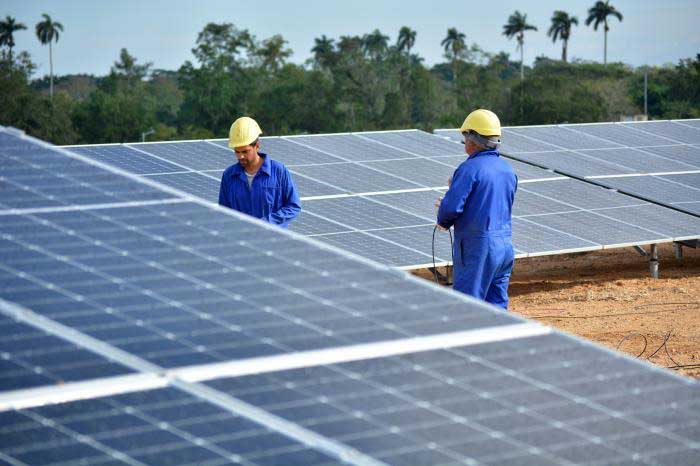
The installation of 52 solar photovoltaic parks has been completed, contributing more than 1,000 MWp and generating, at peak output, 38% of the energy consumed during daylight hours.
10,185 of the 10,259 solar photovoltaic systems intended for teachers, doctors, and labor heroes have been installed. Additionally, 5,000 solar photovoltaic modules are being installed in isolated communities, for children with disabilities, in polyclinics, health centers, maternity homes, nursing homes, and other basic services for the population.
Battery stations with a capacity of 200 MW are being installed to stabilize the grid by regulating frequency in response to system fluctuations.
More than 6,000 homes are already connected to the National Electric System (SEN) via photovoltaic systems.
There are 762 solar-powered pumps in water systems for the population and 462 solar-powered pumps for agricultural irrigation. Meanwhile, investments in hydroelectric and wind power are progressing, as is the case with Herradura 1 and 2.
Work is also underway to connect 25,000 new consumers to manufactured gas in Havana, of whom 735 have already been connected. Natural gas is also being installed in communities where natural gas seeps have been identified, starting with the village of Jobo Arriba in the municipality of Imías in Guantánamo, where the first 14 homes have already been connected.
In Havana, six bakeries were connected to manufactured gas.
5,611 windmills and 566 biodigesters are being rehabilitated.
Coal and wood-fired ovens have been restored in bakeries: 785 across the country can now guarantee the production of around five million units daily.
INDUSTRY
Eloy Álvarez Martínez, Minister of Industry, noted that business management has been transformed to rely less on funding from the central account and move toward financial self-management, also incorporating energy autonomy as a strategic pillar.
He said that six self-financing schemes have been approved for business groups and the company Copextel, allowing them to retain part of their foreign currency revenue to address problems, which in turn serves as an incentive to increase exports.
Amid these complexities, businesses with foreign capital have been strengthened —the industry currently has 27 such entities—, as well as internal alliances with technological and commercial partners, which have facilitated shipments and the procurement of raw materials for the country.
“Thanks to these supply chains, a significant volume of inexpensive containers, polypropylene bags, battery products, and textile goods, among other items, is now being produced. In the refractory industry, construction materials have been manufactured, and cable production has begun through a partnership with a private MSME,” he stated.
Meanwhile, the Recycling Group, using its own revenue, plans to launch processing facilities for raw materials this year. Fuel for nitrogen and CO₂ production has been secured, keeping the country’s 48 small production plants operational.
ALTERNATIVES FOR THE WATER SECTOR
Meanwhile, the president of the National Institute of Water Resources, Antonio Rodríguez Rodríguez, explained that there are 3,300 pumping stations in the country, of which 211 are gravity-fed and 834 already have solar panels. In other words, 33% utilize these alternatives.
However, these are the smallest stations. And that benefits—he pointed out—only one million residents. This leaves 87% of the population dependent on the SEN.
Given this situation, “we have worked with the Electric Union (UNE) to select 480 stations —out of the 2,200 that depend on the SEN— that serve the largest population. Of those, 135 are in protected circuits. Of the rest —he noted— we have 73 with generators, but they are also limited by a lack of fuel.
Rodríguez Rodríguez stated that, “together with the UNE, we have already begun the second phase of the energy matrix transition. For example, we have already acquired all the components for 22 electric vehicles in the capital that will allow us to work on leaks and blockages, as well as on the operation of the aqueducts.”
In addition, “we already have three charging stations in the capital. One of them is the country’s first fast-charging station with storage capacity for heavy-duty vehicles. We will soon have an electric drain-cleaning truck and an electric septic tank cleaning truck, as part of the process to find solutions that do not rely on fuel.”
This quarter, we will construct approximately 29 km of water supply infrastructure and 3 km of sanitation infrastructure nationwide, benefiting 189,000 people.
“We will continue the pipeline from Carlos Manuel de Céspedes to the Mogote Uno pumping station,” he said. “We will continue the Marino-Palatino pipeline. We are working on the Quintero water treatment plant and other small projects, depending on the country’s fuel availability.” (Granma)