


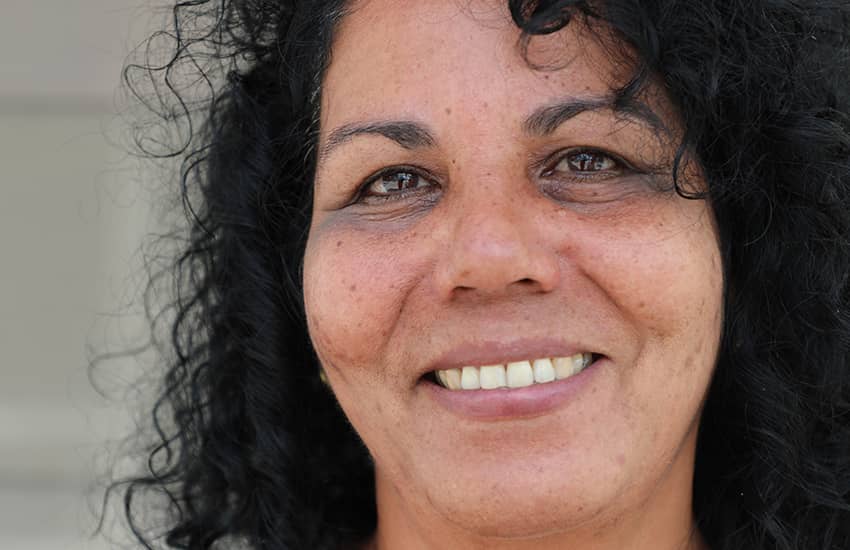
A woman who dreams is a woman with wings, even if they cannot be seen, even if she does not soar through the immensity. Art critic Iris Cruz Núñez is one of those beings who, without intending to, make her presence felt in the complex and beautiful ecosystem of culture.
Her childhood was spent among trails, rivers, trees, and fruits, without suspecting that one day her path would take another direction. Of course, these roots always accompany her, which is why she loves to write about Creole traditions, rural roots, recipes, and other topics. The example set by her mother, who had six children to raise, planted the unshakeable seed of her character, a mixture of sweetness and steel, even if her bluntness is not always well received.
There, in La Jibarera, near Yariguá, she took her first steps on the land that held a magic impossible to forget. Paradoxically, she confesses, she was a shy girl who did not grow up among books, only toys and the occasional doll. “I had practically no idea what a work of art was. I was far from cultural institutions, from any gallery...”, she says today, more than 50 years into her life.
There was a time when medicine would rob her of her sleep, but the “clinical eye” of Carlos Tamayo, former president of the Union of Writers and Artists of Cuba (UNEAC in Spanish) in the territory, would motivate her to study art history. "That decision changed my life. I loved being in contact with young people who had a different culture. That's how I became interested in various forms of expression. It was a world that opened up before me, and the funny thing is that we learned from slides.
"After graduating, I waited for approval to work at the Cuban Cultural Property Fund (FCBC in Spanish), where I stayed for 28 years. I have always been close to creators, whether promoting their work, writing for catalogs or magazines such as Quehacer, from our province. I have also collaborated with the newspaper 26, perhaps because of the connection I have had with journalism students since my studies, or simply because of my vocation for storytelling," she says.
Although she has delved a little deeper into the visual arts, other cultural universes have also captured her attention. It is no surprise that her list of achievements proudly includes a contribution to the celebration of the 40th anniversary of Art Education here. "I proposed activities that were carried out and turned out very nicely. That is something I cherish dearly. However, it is true that the visual arts have occupied me for a long time; I was even devoted almost entirely to that art form for around two decades. I even have a book project on its history in the province, which is still unpublished," she reaffirms.
She clarifies that art criticism is not studied, something with which she disagrees, because "creating content and delving deeper into the subject is also a kind of creation. It is a profession that is not chosen, but rather formed as you discover that you have that aptitude. Then you accumulate knowledge and feel the urge to share it. Associated with ‘it’ are curatorship, museography, and other aspects," she says.
Life stories, works on music, theater, and various forms of expression, as well as research projects on the agenda, color the work of this woman who, instead of being called Iris Cruz, could be named Iris Luz.
However, she agrees that the work of the critic is not always understood; quite the contrary. “An artist does not take kindly to having their work questioned, but determining what positive or negative, avant-garde or trite elements a work possesses is part of our job. We shed light on creation.”
For this reason, she believes that art criticism should have its own section within the UNEAC (the institution of which she is a member) in order to broaden its field of action. She also advocates for it to be included as a subject in study programs related to the sector.
Meanwhile, she writes texts on the internet, discovers new horizons, embraces teaching, and continues to pursue her entrepreneurial side, which has led her to explore the secrets of handmade soaps, scented candles, and other products. “Women have immense scope for determination and creation. We just need to awaken that sensitivity, and we can do whatever we set our minds to,” she concluded.