

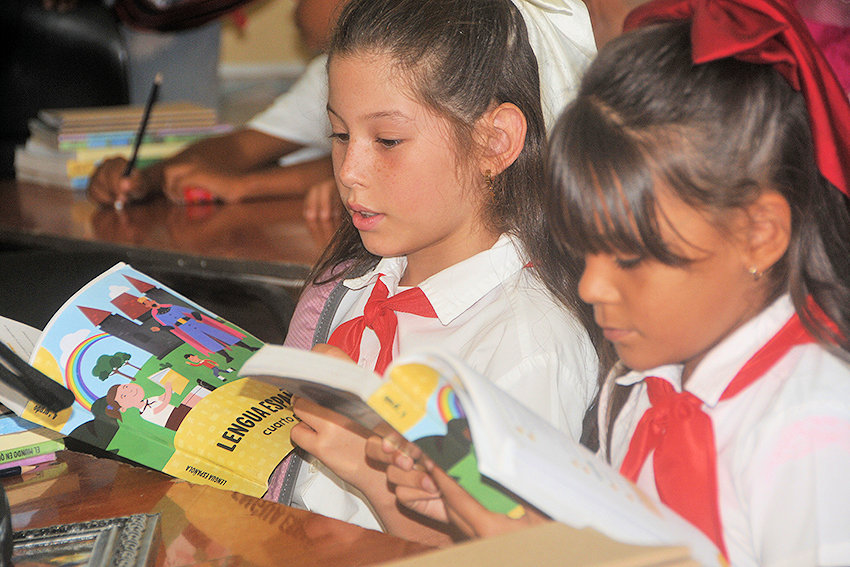
The 2024-2025 school year officially closed on Friday after the Central Ceremony at the Ernesto Che Guevara pre-university institute in Vázquez, Puerto Padre. This teaching period ended with the intensity of what was experienced: final exams, worn-out backpacks, longer hugs, and the nostalgia that silently settles in the hallways and the blackboards.
A mixture of relief and melancholy pervades the schools. This is how this “see you soon” unfolds, repeated year after year, but always feeling unique. Because in every classroom, there are stories that cannot be summed up in a grade.
ROUTE AND COMMITMENT
Amid this emotional pause, the Las Tunas education system is already looking to the future. The Rita Longa Pedagogical School hosted the Provincial Seminar in Preparation for the coming school year, in which administrators, methodologists, and teachers evaluated the results of the year that is ending, with an eye toward the missions that lie ahead.
“The Ministry of Education proposes six strategic objectives, nine key processes, and more than 120 efficiency indicators,” explains Juan Miguel Barrios, deputy director general of Education in Las Tunas, who details that among the priorities of the new teaching chapter are the improvement of political-ideological work and the teaching of Cuban History.

“This has been a course that has been achieved with considerable sacrifice, especially in terms of teacher coverage,” says Maricela Fernández Vega, director of the provincial technical advisory team at the Diagnosis and Guidance Center, while delving into an indicator that performed at 95 percent.
The specialist points out that, in the face of staff shortages, the sector resorted to various alternatives with a great sense of responsibility and dedication. Noteworthy are the implementation of Resolution 10 of the Ministry of Education, which guarantees the continuity of the educational process by increasing class hours for teachers, with their respective pay; and the Educando por Amor (Educating for Love) contingent, which encourages university students to teach content in other subjects.
Preparation for next September was structured in four stages. The fourth stage is currently underway, focusing on direct contact with teachers in each school. At the same time, there is still joy at the graduation of the fourth-year students from “Rita Longa,” who graduated in 16 specialties and will join the teaching profession. Many of them defended their final projects directly in the centers where they will begin their work in front of the blackboard, a pedagogical experience that strengthens the link between training and professional practice.
A UNIVERSITY THAT TRANSFORMS ITSELF ALONG WITH ITS ENVIRONMENT

One of the bastions of the local education system is the University of Las Tunas (ULT in Spanish), which, among its advances, highlights its integration with more than 30 entities in the territory, thus strengthening the ties between academia and the productive and service sectors in areas such as food production, renewable energy, and sustainable local development.
Specific experiences stand out, such as the projects with Duralmet, Thaba, Mantenimiento Constructivo, and the Beverage and Soft Drink Company, as well as the actions of the Chair of the Environment, which has promoted ecological practices in schools and communities. The challenge is for each research project, as has been pointed out in the follow-up meetings, to materialize into real impacts.
In this context of renewal, the ULT will graduate 1,281 students on July 21: 261 from the daytime course, 387 from the evening classes, 11 from distance learning, and 13 from the short-cycle higher level. A total of 609 students will graduate from the municipal university centers (CUM in Spanish).
There are 103 gold degrees at the main campus and 61 in the municipalities. In addition, 33 Scientific Merit awards will be presented. These figures speak to the commitment and expertise of the faculty, which has also been recognized by the National Accreditation Board, which externally evaluated nine of the 30-degree programs offered by the institution.
Danis Figueredo Espinosa, PhD in Science and Vice-Rector for Professional Training, emphasized methodological preparation as a guarantee of a quality educational experience, although he acknowledged challenges such as declining enrollment in pedagogical disciplines.
HARVESTING AT THE ROOT
During the school year that is coming to an end, a new primary school was born in Las Tunas, in the community of Palancón, the municipal capital. Five classrooms and 132 students from preschool to fourth grade put their stamp of hope on the goal of always encouraging the light of knowledge, despite the difficult economic context.
Primary and secondary education also experienced the intense process of the National Assembly of the José Martí Pioneer Organization (OPJM in Spanish), on the occasion of the 64th anniversary of this organization. The children showed their lucidity and love for their country by being as concerned about the teaching of history as they were about their contact with the community.

Meanwhile, the province's results in the higher education entrance exams were “slightly lower” than the previous year, according to education authorities, although the territory remains among those with the best averages in Cuba in this area. In any case, this situation will require new assessments of what else can be done to avoid further decline.
If we review the events of these months of classes, we will find multiple activities and initiatives outside the classroom that inspired and motivated students. The recent Provincial Workshop on Martian Forests, Gardens, and Orchards—which linked the Apostle's thinking with identity and the environment—rewards this catalog and speaks to how much can be done to promote experiences that point to a more comprehensive and sensitive educational process.
Summer is now beginning as a necessary break. The vacation plan will start on July 19, coinciding with the end of teacher training. Despite economic limitations, villas, camps, and pioneer facilities have been set up for the enjoyment of students and workers in the sector.
The summer break is also a time to breathe, share with family, and recharge. The school closes its doors for only two months, but it always leaves a light on.
Las Tunas, as it does every year, once again demonstrates that education is not just about curriculum, but also about affection, community, and the future. And in that future that is being prepared today, thousands of new stories are waiting to be written.