

- On June 14, the Ernesto Guevara Hospital celebrates its 45th anniversary. Its history is made up of many names; Isora's stands out among the golden ones.
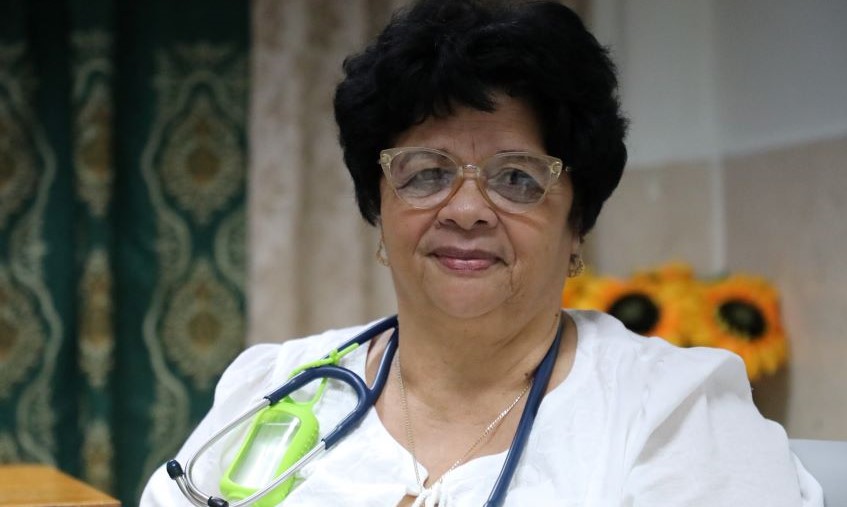
To the rhythm of the stethoscope crossed around her neck and with the tape recorder postponed amid the rush to return to her students, the conversation with Dr. Isora is more than a profession, it is a creed subject to Internal Medicine. She carries the “reputation” of being elusive in front of microphones, but underneath her white coat is a living pact to engage her instinct and faith in saving lives.
She tells me that since she was a child, she knew where her path would lead. Even though there were no doctors in her family and she had no one close to her who awakened her vocation, she arrived at the Luis Urquiza Jorge Pre-university Institute with a clear purpose: she would be a doctor. She discovered her specialty later, like a second love, and when it came time to choose, she felt no uncertainty.
"I was lucky to receive motivation from my professors during my studies, which made me see medicine differently. To assume that love is the only recipe for dealing with any service, that you have to detach yourself from personal problems, from external conflicts, put everything aside, and focus on the person in front of you, who needs help and deserves our attention.
"Since I learned about the specialty, I had no doubts. There were no other options, and there still aren't today. I have always been devoted to internal medicine. And interviewing the patient, listening to what they have to say, observing them, had a lot to do with that. I feel that we achieve a great connection with the person on the other side, and without those tools, you can't be a clinician.
"I am very strict with my students, and I repeatedly make it very clear to them that our specialty emphasizes comprehensive care, in-depth physical analysis, and constant study to reach a diagnosis. I never stop preparing; updates and new approaches are published.
“Of course, choosing to be a clinician means setting yourself a big study goal and then taking on a greater workload. But without that sacrifice, you can't build a career in this field. There are no shortcuts here.”
THE EVERY DAY “PACT”
Isora Magdalena Sánchez Lorenzo first crossed the threshold of Doctor Ernesto Guevara General Teaching Hospital more than 40 years ago. She recalls, with a laugh, those early days of large gatherings when many of the leading teachers came from the country's capital to train the next generation who would carry on the most vital services.
She remembers that when she graduated as a specialist, in the fourth graduating class, there were already doctors from Las Tunas with proven talent in crucial positions at the largest hospital in the province. She treasures those vivid memories of professional growth in her homeland and a sense of belonging that came naturally.
"When I hear people talking about ‘Guevara,’ I can't stay on the sidelines. I feel it is something personal, and every negative comment hurts me. This hospital is like my second home. I have dedicated most of my life to it. Those of us who are here, in such different moments and stages, have seen generations of doctors grow and mature, and we have witnessed, firsthand, the quality and commitment of the health sector."
“We are living in complex times, with shortages of medical supplies, human capital, and so many resources, but the key to continuing to save lives is the same: putting the patient at the center of our priorities, focusing on their needs to achieve an accurate diagnosis. Every human being's time is worth its weight in gold.”
A UNIQUE MAP
Talking with the Second-Degree Specialist in Internal Medicine is, in a way, to delve into the wealth of knowledge she has acquired as a master's in Emergency Medicine and a doctor in Education Sciences. It also strikes me as being like looking at an X-ray of this land we all walk on.
"The condition we deal with most is high blood pressure, which is what we treat most and see most often in the ward. We are concerned because we have observed that it is directly related to poor eating habits, lack of regular physical exercise, and unhealthy routines."
"We have to talk to people a lot, especially in the context of a lack of medication. Hypertension requires healthy lifestyles, which must be practiced, taught, and reproduced in families from an early age. After diagnosis, there is already a problem to treat, hence the importance of prevention."
"The consumption of tobacco and alcoholic beverages and the harmful effects of these addictions are alarming. Cardiovascular diseases also concern us. The reality in Las Tunas is largely marked by these conditions."
SKILLS THAT SAVE LIVES
It is nice to hear her talk about the patients she cannot forget, about the fear that still invades her from making a mistake in a diagnosis, and that the weight of that mistake could end a human life. There is an amalgam of sensitivity behind the elegant manner in which she conducts herself.
“You never lose the fear of making a mistake, that's what I tell my students. That concern makes you better; it leads you to study, to not believe that you know everything. In this profession, you need a large dose of humility, because at the end of the day, what matters is that the patient is well.”
With her incorruptible ethics, she tells me that while we are talking, she has an elderly woman in the ward. Although she arrived short of breath, all her tests have come back negative, but “that lady is not going home.”
"It's hard to explain, it's a matter of instinct or the experience of having seen a similar clinical picture before, the fact is that you feel when something is wrong, even if the tests are normal. In those cases, I don't take any chances; the person stays in the hospital so we can monitor them closely. Otherwise, I wouldn't be able to sleep peacefully."
“That's why I insist so much on looking at who we're treating, on the physical exam, on the ability to act in time. You have to get involved.”
TEACHING, A PASSION
On several occasions, 26's microphones have heard Dr. Isora mentioned as the inspiration that brought so many doctors to their current goals. Everyone agrees that her classes are educational and sometimes a little intimidating.
"I loved teaching from the beginning, and that's the path I took. I like lessons that leave a mark on students, that bring them down to earth to the reality that brings us together. I'm not one for half measures; I'm rigorous. I encourage them to set goals and grow professionally, to exploit their potential."
“I like to think that I contribute to their comprehensive training, because to be a good doctor, you have to be a good person. The new generations need accurate guidance and inspiration to recognize that this is a profession of love.”
Back in 1988, she stood in front of the blackboard for the first time and has not stopped doing so since. At the same time, she honors her vocation as a researcher. She is the head of the Clinical Epidemiological Characterization of Hypertensive Patients in Las Tunas project, which culminated in very satisfactory results.
Currently, Isora is researching the clinical epidemiological method and its application in the medical profession. In addition, she investigates topics related to nephrology as an adjunct professor in this specialty. She was recently honored with the status of consulting professor of medical services.
FLOURISHING FOOTPRINTS
She mentions a large group of students who have become brilliant professionals and are now in very different places. She also talks about how beautiful it is to see the next generation grow up in such complex contexts. It is difficult not to notice the “teachers” sprouting up everywhere around her.
The fact is that Professor Isora is a treasure trove of knowledge that has been built in the shadow of “Guevara.”
They are inextricably linked, much to the luck of the people of Las Tunas. Her career has been uninterrupted, even though motherhood has made her blossom with another daughter, and she has been outside Cuba twice on internationalist missions, and sadness prevents her from talking about that period.
She walks with a fine, elegant gait. A dozen students await her, a room full of new faces and the occasional research topic resting in her work bag. On the other side of her stethoscope, on her chest, she carries the instinct of someone who always looks beyond the obvious, because medicine is a profession of riddles that she likes to decipher.