

He was following his mother around, as he almost always did, but his early childhood innocence protected him from what was about to happen. He did not notice any signs that her health was changing, nor did he notice the concern in her eyes. Suddenly, his mother went into labor. She could not make it to the hospital and gave birth to his sister right there, in front of him.
Rabiel was a little over two years old and had been touched by a very unusual experience: he had witnessed a birth for the first time. Time later distorted the memory, but it had definitely marked a path that life, or luck, was pushing him to follow.
At the age of 14, in the midst of the CDR movement, his early involvement in mass organization earned him recognition in the form of participation in the inauguration of the Ernesto Guevara Hospital. He left his small hometown of Chaparra, Jesús Menédez, at dawn. The building seemed monumental to him, and the white coats excited him... He never imagined that this place would guide his steps.
...
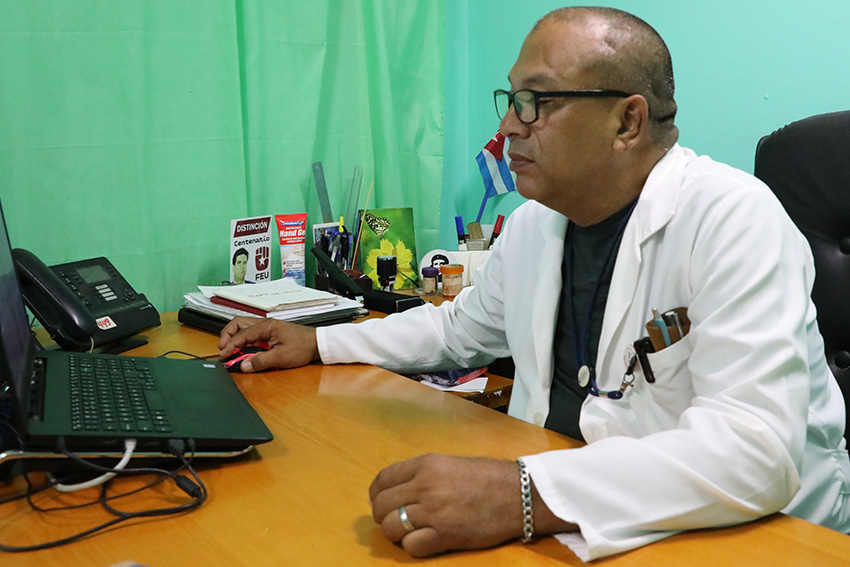
Behind the microphone, Dr. Rabiel Cárdenas Peña does not talk much about his status as a second-degree specialist in gynecology and obstetrics, his skills as an assistant professor, associate researcher, or his master's degree in Comprehensive Care for Women. His eyes shine when he talks about the exact weight of a newborn that cries or does not cry for the first time. He assures us that “that little body is worth the world.”
“I was an underweight child. My mother had a preterm birth, and therefore, there was a risk there that I later understood with the magnitude it requires,” explains the doctor. All the experiences of my childhood, those I was told about and those I remember, gave me an extra sensitivity towards women who are going to have a child and the baby on the way.
"Medicine was not my first choice. In 1983, when I had to choose a career, I applied for a military course that was being studied in Holguín. But due to ‘luck,’ I had an accident and was unable to pursue this dream. It seems that life was forcing me to go into healthcare. So when I finished twelfth grade, I decided to become a doctor.
“I have so many memories of the early years... We were the first class to start here, from the first to the sixth year of the medical degree. Around that time, the new Zoilo Marinello Faculty of Medical Sciences building really began to take shape. Today, I have been a doctor for 35 years and a specialist for 32, because I had the opportunity to take the specialty route directly.”
He recalls that Machado Ventura was present at the founding of the detachment and at the first graduation held in the province itself, and from a distance, he could also see Vilma Espín. His contingent was born marked by commitment.
"When I had to choose my specialty, I didn't think too much about it. My life had been marked without my realizing it. I was aware and accepted that it had to be gynecology. Fortunately, it was the right decision."
DIFFERENT SCENARIOS, THE SAME GOAL
Dr. Cárdenas began his career in the municipality of Majibacoa, where it was most needed at the time. "There, I became a teacher. I was the head of a basic group working to train specialists in comprehensive general medicine. Then I was given the task of running the 7 de Noviembre polyclinic, in the same area, and I really learned the weight of responsibility.
“In my working life, I have been in many different scenarios, and when I have been called upon, I have responded. That's how I ended up at the Aquiles Espinoza polyclinic, then at the Municipal Health Department, working in the Maternal and Child Program in relation to my specialty.”
From then on, his resume grew considerably. This is evidenced by his remarkable performance in four international missions where he had to shed his nostalgia and immerse himself completely in the hustle and bustle of this service in Africa and other latitudes where childbirth is associated with various complications due to cultural biases.
There are stories and faces that the doctor cannot erase from his memory and that taught him to respect his profession and find the strength to rekindle the sensitivity and love that must go beyond the white coat.
He proudly treasures the internationalist mission medal, the Medal for Cuban Education. He was one of the first to pursue a master's degree in Comprehensive Care for Women in the province and later became president of the academic committee for the program. He says he owes his successes to his family, to his parents. Without their support, he would not have been able to get involved in so many projects.
"In my comings and goings, I returned to Guevara Hospital, worked as a caregiver, and was head of the Teaching Department of the Maternity Ward. Then I was the deputy director of teaching at the institution, went on a mission, and now I am again in charge of teaching at the hospital. At the same time, I have directed the Provincial Gynecology and Obstetrics Group for 17 years, in several periods.
CHALLENGES TO BE ACHIEVED
"I am not yet satisfied in my specialty because there is still much to be done. I believe there are things that motivated me and marked my life, as I told you. I am a gynecologist, and if I were sent to study again, I would become a gynecologist-obstetrician. I also had the opportunity to become a perinatologist, a diploma within the specialty.
“I started at this hospital on the teaching side. I had a professor who was always the head of teaching here, and I learned from him. Later, he accompanied me in my efforts to improve. I owe a lot to professors Reymundo Capote Arce and Julio Antonio Pérez Pantoja.”
He speaks passionately about the immense responsibility involved in training a student because, along with knowledge, there must be values, ethical concepts, and principles that cannot be compromised. That sense of belonging made him president of the Las Tunas chapter of the Scientific Society and a member of the national board of his specialty for four years.
FOR THE NEW GENERATIONS
"I have three things to say to future doctors. One: know that there is nothing more beautiful than saving a human life. Fatigue, schedules, salary... none of that can matter more. Without hesitation, I would choose to be a doctor again.
"Second: my specialty is beautiful; it is working with and for two people. A baby inside and a mother who is achieving something invaluable to her. With the quality of our work, together with neonatologists and pediatricians, we guarantee the permanence of life. That is unmatched. Development indicators are set around the world.
“And the other important thing: study hard, work as a team, listen to all the advice from doctors. What is at stake is the most sacred thing in the world: the well-being of two human beings.”