


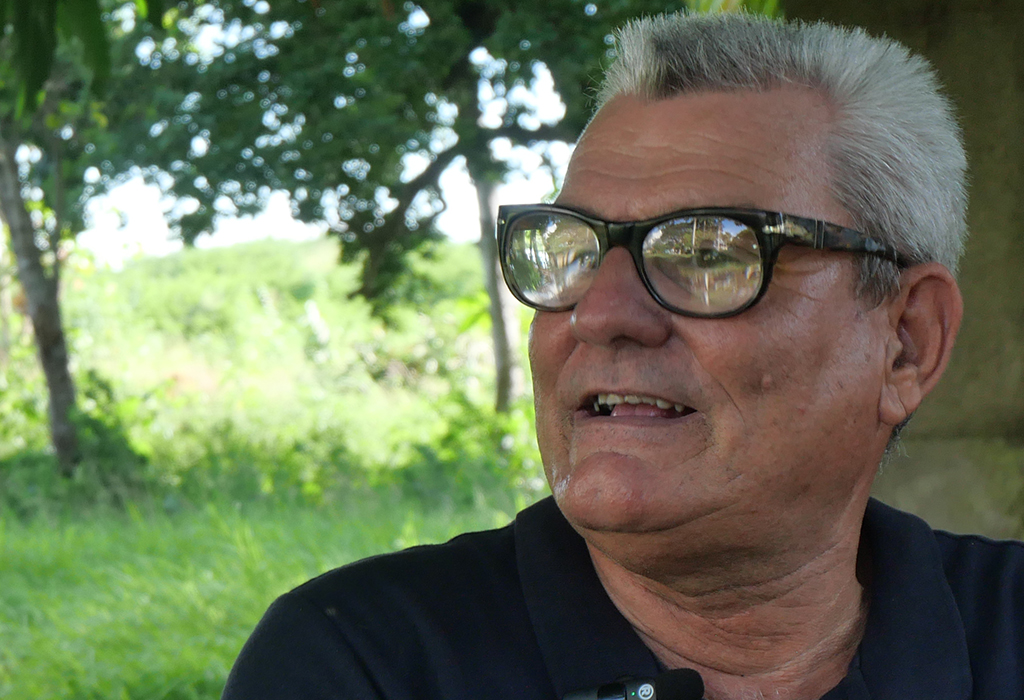
The official activities of the 26th National History Congress began this morning in Las Tunas. However, for several days now, the Organizing Committee and participants have been actively working to put together a worthy event. 26 took advantage of one of the few moments of rest for Jorge Luis Aneiros Alonso, president of the Union of Cuban Historians (UNHIC), and the conclave, to delve into the foundations of a long-standing and necessary event.
Las Tunas, Cuba.– “This is a scientific congress organized by UNHIC with other institutions, especially the host province.
“The first National History Congress took place in October 1942 and met for three days in Havana. It was convened by the Society for Historical and International Studies, founded by a group of contemporary intellectuals led by Emilio Roig de Leuchsenring, the first Havana historian, to promote the country's history in a much broader sense, taking it beyond the academic walls, and even extending it to territories outside the capital.
"That's why it has had many editions in other places, specifically Matanzas, Santiago de Cuba, Cárdenas, Trinidad, and Jiguaní."
"After the triumph of the Revolution, it had one edition in 1960. And eventually, the 13th National Congress of the History of Havana was held. There was a hiatus of more than eight years until the Cuban Historical Union, at its 3rd Congress, in 1995, agreed to reestablish national history congresses in Cuba, reclaiming all of its founding values and adapting them to current times.”
The event is held for the first time on the Cuban Eastern Balcony. Expectations among locals and scholars alike are high. Aneiros knows this, smiles, and explains.
“Las Tunas has its own local, regional, and provincial history, with several scenarios of national impact. It is undeniable that some events, due to their connotation, remain within a more local framework, while others transcend the country and even beyond.”
“In the case of Las Tunas, the fundamental setting lies in the wars of independence. It is one of the first territories to rise in arms after October 10th, the 13th. That is why Congress is inaugurated here on this date.”
“We deeply regret that death prevented valuable colleagues like Plácido Infante Cruz, Víctor Manuel Marrero, and José Guillermo Montero, among others, from being able to join us. They contributed for years to the work of historians here, in many ways.”