


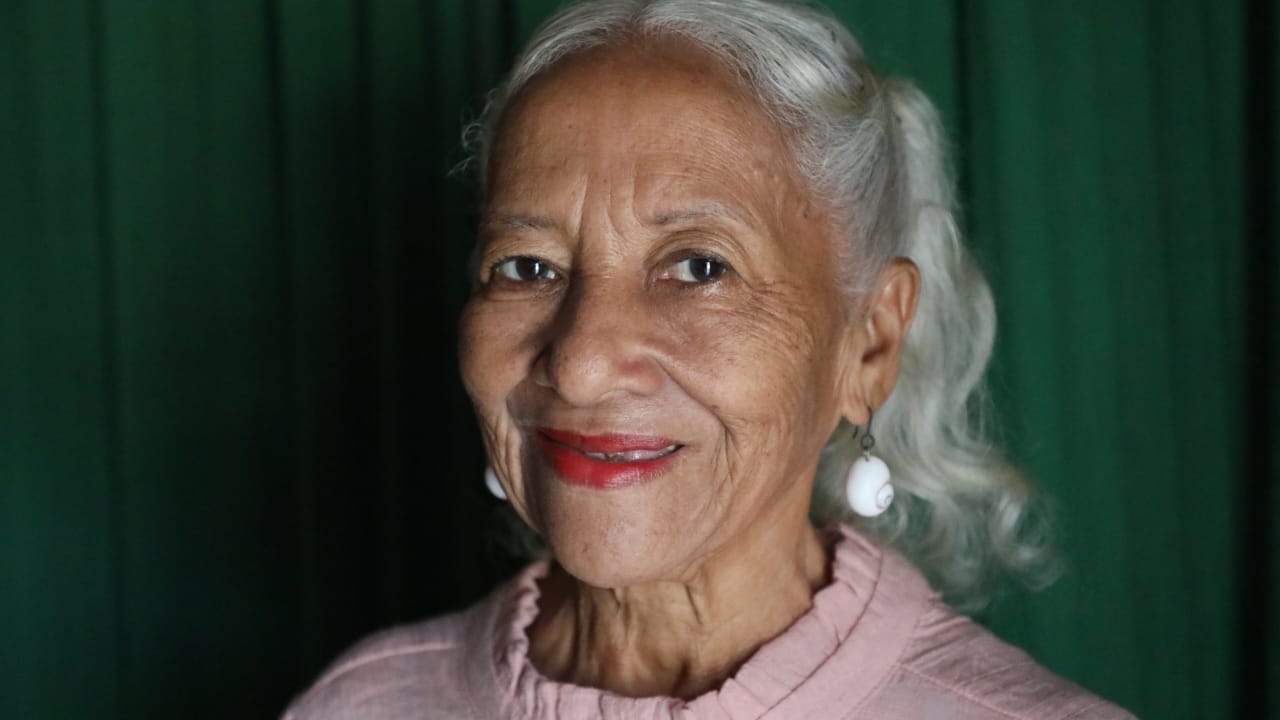
Amelia is not only a beautiful name; it also carries a meaning that its bearer honors every day: a hardworking bee. And it’s no wonder, because we’re talking about a 71-year-old warrior who has dedicated more than 50 years to teaching. Professor Amelia Gutiérrez Cutiño, of the University of Las Tunas, has made the history of Cuba her life’s work for decades; and the idea of retiring has never —not even for a moment— crossed her mind.
As an eternal pollinator of knowledge, she acknowledges that she simply never stops; “I’m working all the time,” she asserts. A native of Las Tunas, born right in the heart of the city, she has always possessed that spirit of leadership that characterizes good souls. She recalls that as a child, the other kids followed her and listened to her… Today is no different.
She is a guide to her colleagues, an advisor, a consultant; she is a source of joy for her department, a wellspring of experience and learning, and she never tires of saying that she is a “tremendously happy” person. However, teaching was not her original goal—it was Industrial Sugar Chemistry—and she achieved it. But she didn’t count on the fact that fate has its own “twists,” often outside of one’s plans. A family situation prevented her from enrolling in that program, and her path changed… for the better.
“I stayed here, but it turned out I also really liked math —I even worked as a teaching assistant— and one day my math professor came to see me. I told him what had happened, and he went to the university in Santiago de Cuba and managed to get me admitted. But when I arrived, they told me that the only option left was the teaching program. And since I didn’t like teaching at all, I chose the subjects I considered easiest —in this case, Spanish and History. I think I was destined to be a teacher,” she recalls.
And Amelia has truly remained true to that destiny. Her hometown welcomed her back as a graduate in Spanish and History for middle and high school education. She began her bachelor’s degree and was part of the first graduating class from Las Tunas. Since then, she has never stopped striving to improve herself and has earned more than 50 certificates and postgraduate degrees, in addition to her master’s degree in Educational Sciences.
In 1991, she joined the National Commission for the Accreditation of History Teachers in the province and later moved into higher education to continue training future professionals and be a source of pride for that institution. In addition to the world of teaching, she has left her mark on various organizations, primarily the Committees for the Defense of the Revolution and the Federation of Cuban Women, in which she has been active since she was very young.
The opportunity to fulfill an internationalist mission is another of her achievements. Amelia answered the call to teach a group of professors at the National University of the Armed Forces in Barinas, in the Bolivarian Republic of Venezuela. At that moment, her honor was multiplied.
As if that weren’t enough, she has also left her mark on the Union of Cuban Historians —a chapter she considers one of the most beautiful in her life and which she joined upon graduation. Once she began her professional career, she was invited to a meeting where she was nominated for the Executive Committee, a position she held for several years.
The José Martí Cultural Society is another organization she chose to embrace. “I’ve always loved Martí,” she confesses. “I’ve followed him. He’s a role model that we Cubans cannot forget. We must keep him in mind at every moment of our lives, in every action, in every word. Because he is the man who, like Fidel, spoke for all time. So we must follow him,” she reflects.
Although becoming a teacher was not part of her dreams, she discovered in teaching a world she has never been able to let go of. When asked what has kept her teaching for so long, her answer is clear: a force greater than herself that drives her to go there every day.
“The love I feel for my career, for my students —because they’ve all been like my own children. From the moment I teach my first class, and they connect with me —and vice versa— they become part of my life. So I can’t walk away; that’s not part of my life plan.” More than five decades of teaching haven’t been enough for her. Her thirst to do better drives her to strive for even greater excellence. That’s why she continues to learn from others and to put her heart where it’s most needed.
“To have good teachers, you need a strong sense of purpose, and this is based not only on observing the teachers you have but also on loving the profession —which means loving yourself and loving life. If you don’t love your profession, you can’t commit to it, and if you don’t commit to it, you’re really abandoning it.”
Amelia’s commitment and dedication have also been made possible thanks to the unconditional support of her husband, who came into her life when they were both very young, and together they’ve built an enduring relationship spanning more than 50 years. An inexplicable bond that only those who experience it can understand.
“Joel is my other half; we are one person. He’s my driving force; he’s constantly by my side, advising me, helping me, which gives me tremendous encouragement. We don’t have children, but I tell him, ‘You are my son, and I am your daughter. You are my boyfriend, and I am your girlfriend, your wife, your partner,’” she says emotionally.
Among her many honors, she has been awarded the Pepito Tey Medal and holds the Abdala Prize, granted by the Martí Youth Movement, with which she has worked extensively on all its events. She has also received other awards from the Union of Historians of Cuba.
We'd like to continue our conversation with her because we know she still has so much more to share, but duty calls and the classroom awaits her. In just a few minutes, Professor Amelia showed us that she won’t let her 71 years hold her back, because her main driving force is the desire to keep moving through life filled with joy, love, and good values. Her students —those children of her heart— can attest to that.