


- The Federation of Cuban Women (FMC) celebrates its 65th anniversary on August 23. Women from Las Tunas give voice to the greatest challenges they face today within the organization.
The day Odalys Peña Alarcón was told she would receive the August 23rd Distinction, awarded by the Federation of Cuban Women (FMC in Spanish), she celebrated with the strong and playful tone of voice known to her community in Palo Seco, Jobabo municipality. But quietly, she confesses that it was like looking back on her 58 years.
What people don't know is that the next day, she got up before dawn and, when she was ready, she broke through the guardrail and headed for the clearing, in the middle of a very narrow landscape, dodging embankments in poor condition and a zigzag of puddles. She walked 12 kilometers to ensure her presence and commitment to the FMC.
With that same excess, Odalys carries out the work of the organization in her community and proudly recounts the good coordination she has achieved with her 110 federated members. Sincere as she is, she warns that her environment is complex, especially in these times of economic hardship, when the demands of the inhabitants are based on real problems.
“I have been working within the FMC for 10 years, but I have belonged to it since I was a child,” she says. And doing a conscious job is not about sitting behind a desk or at a meeting table, it is about knowing people's dilemmas and accompanying them in the search for solutions that sometimes require very little."
“Palo Seco has its difficulties with roads; it is a complicated place. We went more than two months without water, and the lack of electricity affects food preparation. But its inhabitants are worth a lot, and when I go to them, I don't just do it to collect dues; I try to stay by their side in every situation.”
She tells me about her early days in the Federation. "Every anniversary was a celebration. We would call everyone together, and they would come. We would organize fun activities, and the neighbors' joy was evident. Now the challenge is greater because life is not the same. There is more need and, therefore, much more apathy."
"In the neighborhood, I always say that we can't lose our motivation; we are a group of women who are here to help each other first and foremost. And this applies to dealing with alcoholism, violence against us, and teenage pregnancy..."
"I have to be respected, that's how I put it, you have to be careful how you say things. There is a lack of resources, it's true, but there is plenty of will. On the issue of violence, I never tire of repeating that better management is needed because, as a society, we are not coming up with effective solutions."
“The authorities must get more involved; we must all take ownership of the problem and tackle it together. This is the case with other social issues. Every organization has to join forces; otherwise, the most sacred thing we have, our peace of mind, will be corrupted.”
Talking with Odalys is a reminder of the values of her generation. She is already preparing a caldosa to celebrate the 65th anniversary of the FMC and a Cuban table for the children. She will be the first to go out and sweep and go from house to house, because there they are all one big family, with no one excluded.
Those who know her talk about her tireless energy, her work as a mediator in the community, and her efforts to keep her people well-informed and focused on finding solutions to problems through collective effort.
She tells me excitedly about the momentum her block has in Palo Seco, the respect she has earned as a true federation member. "We are the eyes that watch for danger and support the elderly, the youngest... It feels so good that the FMC is useful and necessary, and not just a slogan.
“Being a federated member is not about talking nicely; in fact, I do it quite loudly; it's about convincing by example and trying to inspire the new generations to be the same or better than us. That's what Vilma would have done.”
UNDER THE UMBRELLA OF UNITE
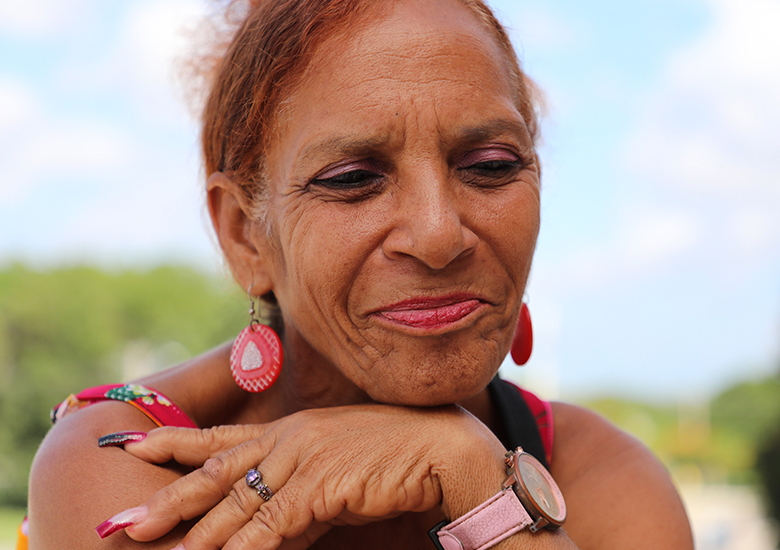 Carmen Rosa Santos Fonseca was a young girl when her mother celebrated her joining the Federation at a neighborhood event. She tells me that she can still see her, with almost tangible pride, because her daughter was following a path that she, in turn, had passed on to her offspring.
From her mother's gray hairs, which were born from the hard work of agriculture, Carmen learned everything that accompanies her today. "Mom had an extraordinary strength that she poured into others, into helping, into bringing people together to tackle the tasks required in the community of El Batey, in the municipality of Jesús Menéndez.
"When she died, I was given the responsibility of leading the block that she had always organized. Imagine the challenge, when the task calls me, it is her I think of. In her time to take care of my father, the house, the whole family, but mainly, with the energy that she carried out her duties as a federated member."
In El Batey, all anniversaries are celebrated, even when times are tough and money is scarce. There are sweets for the children and cultural activities in the morning, and the afternoon is for the adults to share.
"I am sure that the community becomes more united in the activities, it becomes motivated; this is how we give meaning to the dates, because for young people, there is no history to remember, we must bring the new generations closer with facts."
"I am very involved with the federation members, the children run around all day, and it is a peaceful, harmonious environment. That is priceless. Of course, we know that the economic situation is very difficult, and we know in detail who needs help, especially the elderly."
“At the FMC, we take steps to ensure that elderly people without families are admitted to social institutions, to nursing homes, and that they have enough to eat and access to medication. Many members go to clean their houses when they need it, every now and then on weekends. That is also the work of the organization. I always say, humanity above all else.”
She tells me stories about her surroundings, the interventions that are required when there is a power outage, when there is nothing to cook with, the river water no longer flows, and even the water from the wells is scarce. “I talk to people a lot. We have to explain things to them, support them, and make them feel that they are not alone.”
Carmen's sagacity has even led her to schools to talk about phenomena such as alcoholism, addiction, and early pregnancy.
"Life forged me by force. My husband was an alcoholic; there was often a thief who took things from my house, and one day I discovered that it was my own partner, and I ended the relationship. With that experience, which marked me forever, I try to help the families around me."
"I have two children that I had to raise with the help of my parents. The youngest doesn't know his father because when he left, he never came back to see them, but they became professionals and good people. That confidence that you can raise well-rounded social beings is in our hands."
“It's not just now that everyday life is more complex; for a long time, the talks with the federation members have been about the family. We guide them to take care of their teenagers, to know who they talk to, what they do, and what they see on social media. I say with immense joy that my community is very peaceful, and I defend it from the FMC, but I am also the president of the CDR.”
Carmen has worked her entire life in the field of culture, and her efforts to intertwine both issues have made her neighborhood flourish, even in the midst of the current situation. She is clear that being a federated member means being a neighbor, a friend, and in many ways even a mother, because the strength of the organization lies in the diverse faces that inhabit it.