


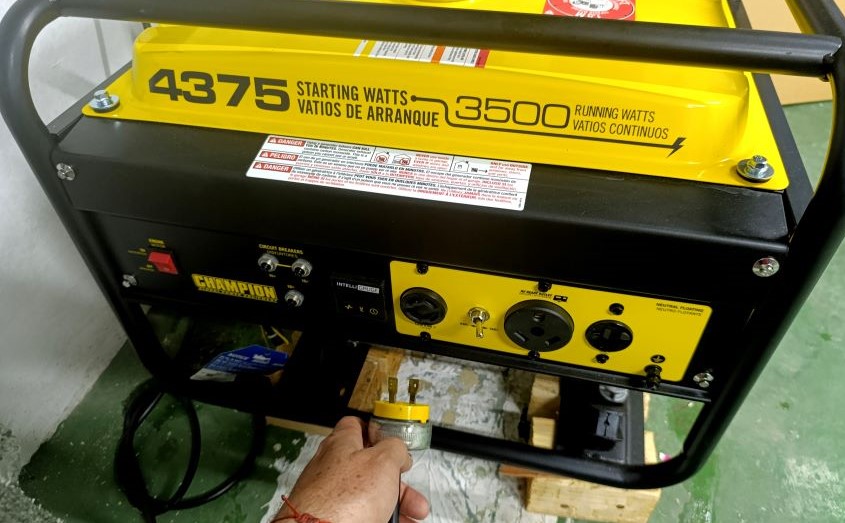
Amid the unyielding darkness of the block, “encouraged” by one of the many power outages, Elia started up her power plant for the first time. It came with all the sacrifices of a son abroad who had paid for the shipment a month earlier so that his family could sleep at night and, incidentally, avoid the annoying concomitance with the coal stove.
Finding gasoline was one of the obstacles on her path to “civilization.” After several attempts and inflation, she finally managed to light up her doorway, like a firefly, amid a groping landscape. But the red letters of the manual were never pronounced in Spanish.
The first location he found for his generator was the patio of his small house, less than two square meters wide and completely enclosed by a high brick wall. He placed it just on the other side of the shutter of the room where he sleeps, because, logically, he did not want it to be stolen, “it would not be the first or the last case...”
The thing is, no one warned him about the dangers of using portable generators that run on fossil fuels. It's true that they don't give off smoke, that you can't smell anything, but all of them, without exception, emit carbon monoxide as a result of the process, a substance known as the invisible killer.
Las Tunas has a sad history of poisonings from this gas, which have caused a great deal of pain to several families. Last year, social media reported the deaths of two people in Amancio, including a young girl, as a result of the misuse of a power plant. It would seem that these fatalities would leave a trail of lessons learned, but no! This is still a cause for concern.
In neighborhoods, the fear of theft causes the owners of this equipment to take risks, which incidentally subjects their neighbors to walking on unstable ground as well.
The Federal Emergency Management Agency (FEMA in English) in the United States, from which much of the equipment used by Cubans today originates, warns that it should be operated outdoors, at least 20 feet away from homes, with the exhaust pointing away from windows and doors. It also states that the use of fans will not prevent the accumulation of gas; in fact, it can make the environment more dangerous.
For the skeptical, there are some very illustrative facts: it has been proven that these small generators can emit as much carbon monoxide as 450 cars. The gas primarily affects the brain and heart; the most obvious symptoms are headache, weakness, dizziness, nausea, confusion, blurred vision, and drowsiness. It can even cause brain damage or death before anyone realizes there is a problem.
In other countries, it is much easier to preserve life because there are alarms to detect the accumulation of this “unwelcome guest.” Here, the irresponsible use of generators in overcrowded buildings or neighborhoods is alarming. It is concerning that the alerts are not constant when health authorities are aware of the peculiarities of these “times of darkness.”
After COVID-19, many were never the same again; those who became seriously ill were left very vulnerable to respiratory problems, especially the elderly. Addressing the phenomenon with caution means taking care of the people we care about.
…
Elia is a cautious woman and removed her portable generator from the window. She now keeps it on her porch, two meters from the door to her living room. She believes she is doing the right thing, but she is playing with variables that could at any moment become dangerous for everyone who, without remedy, has to share the same oxygen.