

Every December 7th, Cuba honors its internationalist martyrs. 26 joins in paying tribute to those who gave their lives for the independence and sovereignty of other nations.
In the context of the Angolan Civil War (1975-2002), thousands of Cuban civilian collaborators carried out reconstruction missions in Angola. Between 1981 and 1983, the situation was characterized by an intensification of actions by UNITA, a guerrilla movement supported by South Africa and the United States, against civilian and military targets. Supply convoys traveling through the country became frequent targets of ambushes.
October 19, 1982, would become a tragically memorable date. On that day, a column of 11 vehicles from UNECA (Union of Caribbean Construction Companies), nicknamed Las Gaviotas (The Seagulls), departed from the Saprel base in Luanda heading south. They were transporting vital supplies through territories where UNITA operated with impunity.
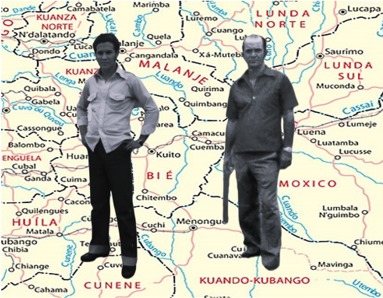
Traveling in the caravan were two men who represented two generations of Cuban internationalists.
Pablo Miguel Betancourt Cruz (Pipo, 48 years old): A veteran of the fight against Batista, he had participated in the capture of the Manatí naval post and in numerous battles under the command of the 12th Column Simón Bolívar. After the triumph of the Revolution, he fought against banditry in Las Tunas. With a life marked by struggle, he arrived in Angola as an experienced driver.
Alcides Alberto Hidalgo Torres (Albertico, 21 years old): A young automotive mechanic from Las Tunas, he had distinguished himself in 1981 by participating in the capture of an Alpha 66 terrorist cell that was planning to assassinate Fidel Castro. A member of the Young Communist League (UJC in Spanish), he arrived in Angola in October 1981, where he worked as a mechanic at the Saprel base.
Although separated by almost 30 years, both shared their roots in Las Tunas and a deep commitment to the Cuban Revolution. The convoy, led by the experienced Carmenate, was traveling along a winding road flanked by dense vegetation. Pipo was driving the mobile workshop with Albertico as his co-pilot. Minutes before the attack, during a lunch break, Pablo had warned of suspicious activity on a nearby hill, but the warning went unconfirmed.
Around midday, as they descended a sharp curve near Saurimo, all hell broke loose. A barrage of fire from the heights surprised the convoy: UNITA had set a perfect ambush.
The first vehicles were hit directly, with shards of glass from the shattered windshield injuring the driver, Jorge Díaz, in the eyes.
Immediately, the convoy members tried to organize a defense from the roadside ditches, following established protocol. In the chaos, the mobile workshop — mistaken for a refrigerated truck — became the primary target of the attack. A burst of gunfire blew out one of the vehicle's tires, causing it to tilt dangerously against the cliff face, sealing the tragic fate of its occupants.
Albertico, feeling cornered, jumped from the cab, but was hit by gunfire in the back. Gravely wounded, he managed to crawl to the front tires of the vehicle and from there continued to defend himself until he was finished off at point-blank range, receiving more than 12 bullet wounds.
Pipo, from the cab, fought with the experience acquired from years of combat. His accurate shots caused casualties among the enemy. As he tried to jump from the vehicle to find a better position, he was hit by multiple fatal shots. His body was left hanging from the car door.
While these two fought their last battle, other wounded caravan members, like El Moro and Jorge, struggled to survive in the ditches. Radio communication was lost at the beginning of the attack. A rescue column led by Carlos García and a Cuban military unit with a BRDM armored vehicle arrived hours later, when the fighting had ceased. It was Palomino, another caravan worker, who managed to reach the mobile workshop and extract the lifeless bodies of both comrades, covering them with a sheet in a final act of compassion.
Six months later, on April 19, 1983, the October 19 Memorial was inaugurated at the Saprel camp. In a solemn ceremony with the flags of Cuba, Angola, and the Young Communist League (UJC in Spanish), a permanent tribute was paid to the two fallen internationalists.
Inscribed on the monument's plaque were Fidel Castro's words that defined them: “They expressed the purity, selflessness, spirit of solidarity, and internationalist consciousness that the Revolution has forged in our people.”
The death of Pipo and Albertico represents the human cost of Cuban internationalism in Angola. They were not professional soldiers but civilian workers who, guided by solidarity and revolutionary duty, faced extreme circumstances far from their homeland.
His sacrifice on the dusty roads of Saurimo encapsulates the essence of that mission, in which thousands of Cubans risked—and, in cases like this, lost—their lives for what they considered a sacred duty: to help a sister nation build its future.
More than forty years later, his memory remains as a testament to an era in which international solidarity was paid for with the highest price, reminding us that some “blows in life, so strong...” -as the verse by Vallejo that inspires this chronicle says-, can only be faced with extraordinary courage and an unwavering faith in ideals.