

- On the 65th anniversary of the Federation of Cuban Women, 26 pays tribute to those whom Commander-in-Chief Fidel Castro called "a revolution within the Revolution."
Early that Sunday morning, Yusnavi felt the weight of her responsibilities in a different way. She was at home, on call, but she was still unconsciously prepared to leave at any moment. That's why she put off almost all her household chores and tried to speed up her pending tasks. It was nearly midnight when the phone rang. Fifteen minutes later, she was on her way to "Guevara" Hospital.
With only three years since graduating as an electromedical engineer, she responded to the notification that a mechanical ventilator in the intensive care unit was malfunctioning as if she were wearing armor. She knew the programming of this equipment by heart, but she did not count on the critical patient, inches away from her, completely vulnerable to her actions.
She tells me that it was an experience she will never forget. Within minutes, she detected that the problem had to do with the flow sensor, calibrated it, and left the room satisfied, her hands damp with tension, but that patient was not going to have any difficulties with his assisted breathing. “I hope he gets better soon,” she said to herself under her breath and returned to her husband.
The next workday arrived at the Provincial Center for Electromedicine, recharged. The imperative to recover the mechanical ventilation equipment crossed her mind as a personal goal because no one knows how painful it is to be there fighting for your life and not have the support of the machines.
A PROFESSION AS A CREDO
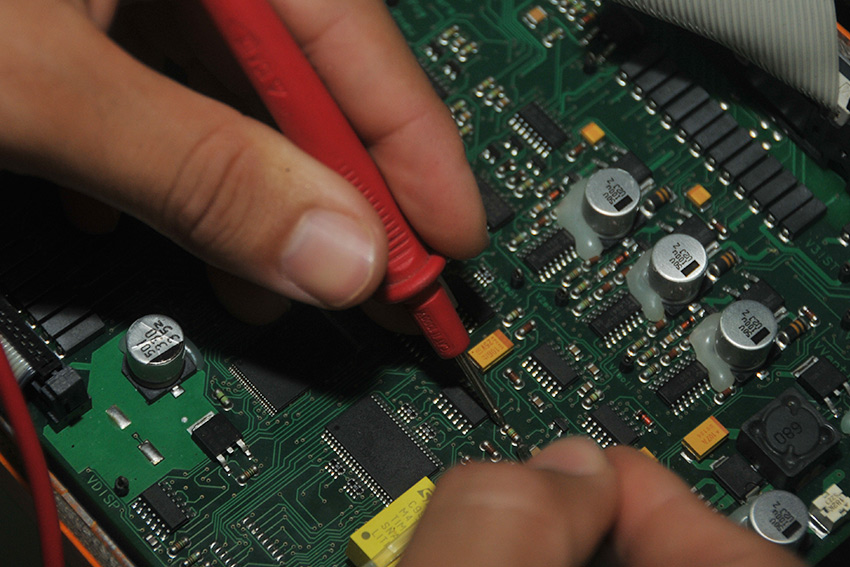
Yusnavi Nápoles Coba is 28 years old and is a Specialist B in Electromedicine. The microphones of 26 find her with her face hidden behind a mechanical ventilator.
"When I started my career, I didn't know what I was getting into. The university gave me the most necessary tools, but getting here and landing in these workshops is very different from what I had imagined.
"All my life, I heard about the economic blockade that subjugates the country, but I didn't understand its true weight. I was simply oblivious. When I started working and took on the responsibility of keeping medical equipment running, that's when I felt the lack of spare parts.
"Here, inventiveness is commonplace. You have to innovate and find solutions because patients can't wait for us. But sometimes you can't work magic; you need spare parts.
“In hospitals, resources are limited, equipment is obsolete, and yet medical care doesn't stop. That commitment is what keeps us here, immersed in solutions.”
She says that, in her career, she has worked in several departments of the Clinical Engineering Specialty, such as Nephrology and Medical Electronics; now, she is passionately involved in Life Support.
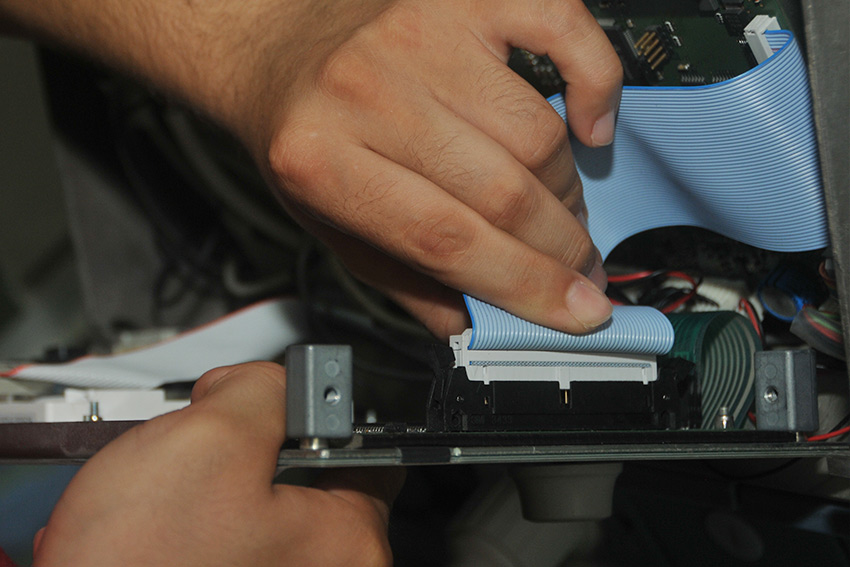
"A few days ago, two donated ventilators were brought to the center to be sent to Guevara Hospital, where they are most needed. When we checked them, neither one worked. Since then, I haven't had a moment's rest. There's something about this job: when you go home, you can't disconnect from the responsibility you leave behind.
“Yesterday I got the first one working, but the second one is more complex because the system is not compatible with the other one, which complicates the routines, but we are not going to give up."
"Now I'm trying to access its card and reprogram it. You have to be optimistic about the process; otherwise, you get stuck, and it's harder to see the solutions. I imagine that these recovery procedures are only done in Cuba because the equipment is so expensive and there is so little availability in hospitals."
“Our team works with an awareness of the value of each piece of equipment, of what we save with innovations, and of the patients and services that benefit. These incentives motivate us.”
As she explains how the machine she is working on works, it is clear that the engineer is not the fearful girl she was in her first months. Three years of training can multiply...
"My time in the Life Support department is a daily challenge. I work with the most sacred thing, the equipment that allows a patient to receive the oxygen they need when they cannot get it on their own. A mistake would be disastrous. Let me tell you that I remain interested and attentive to any equipment I repair, not out of professional pride, but out of fear that it will affect a human being.
"I check three or four times. I am twice as careful. In my free time, I try to research on the internet, try to increase my knowledge and skills, and find out what is being done in other parts of the world. Not me, the Electromedicine service has the seal of commitment and sensitivity.
“Thank God I haven't had any loved ones in intensive care, but when I enter the workshop, I don't focus on one person, but on many. That's the best antidote to cope with the lack of resources and the blockade, which for me now has a thousand faces.”