

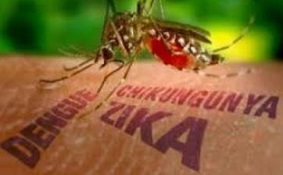
High fever, joint pain that hinders mobility, people of all ages suddenly experience swelling in their ankles, knees, or wrists, as well as an invasive rash that sometimes even affects the face. The reality in Las Tunas right now is marked by the confluence of several viruses, but chikungunya seems to spread throughout the territory, incapacitating a large percentage of the population.
Dr. Aldo Cortés, deputy director of the Provincial Center for Hygiene, Epidemiology, and Microbiology, confirmed to 26 that there is indeed a downward trend in reactive dengue cases, and at the same time, he corroborated that, through surveillance, cases of chikungunya are being diagnosed, with the full magnitude of its clinical presentation.
He also warned that at this stage, there are known cases of people in neighborhoods and communities who, although presenting with fever and joint pain, are not seeking medical attention, and who may have already had chikungunya.
The doctor explained that the current outbreak in Cuba and the province is due to the presence of a population previously unexposed to the virus, as well as the presence of the transmitting agent, the Aedes aegypti and Aedes albopictus mosquitoes. This outbreak likely occurred after the arrival of infected individuals or those incubating the disease from abroad, which explains the progressive nature of reported cases.
"It is transmitted through the bite of infected mosquitoes," the epidemiologist pointed out. "The typical incubation period is three to seven days. The disease can be asymptomatic. The classic clinical presentation in adults and older children is a high fever of acute onset, which can exceed 39°C, and polyarthralgia (pain in multiple joints).
 "Other symptoms include headache, myalgia, arthritis, conjunctivitis, nausea, vomiting, and a maculopapular rash. The fever can last up to a week and be biphasic. The rash generally appears after the onset of fever; it is usually on the trunk and extremities, but can involve the face, palms, and soles, and is pruritic (itchy)."
"It also presents other symptoms such as headache, myalgia, arthritis, conjunctivitis, nausea, vomiting, and a maculopapular rash. The fever can last up to a week and be biphasic. The rash generally appears after the onset of fever; it is usually on the trunk and extremities, but can involve the face, palms, and soles, and is pruritic (itchy)."
"The most alarming aspect is that the joint symptoms are often significant and debilitating. They are usually bilateral and symmetrical, primarily affecting the hands and feet, but alterations can also be observed in proximal joints, those closest to the trunk."
In children under one year old, acrocyanosis (bluish discoloration of the hands and feet) without hemodynamic instability, symmetrical vesiculobullous lesions, and inflammation in the extremities have been described. The acute period lasts between seven and ten days, and treatment is symptomatic." The use of nonsteroidal anti-inflammatory drugs (NSAIDs) should be avoided at this stage.
Cortés emphasized that the most frequent complications of chikungunya include meningoencephalitis, myelitis, Guillain-Barré syndrome, and cranial nerve palsies; less frequently, uveitis, retinitis, myocarditis, hepatitis, nephritis, bullous skin lesions, and hemorrhage. He insisted that people over 50 years of age have a higher risk of chronic rheumatological symptoms after the acute phase of the illness, which can persist for years and be mistaken for a new bout of the disease.
The official urged self-care and civic responsibility and warned that it is important to seek medical attention because this disease can be fatal during the acute phase in pregnant women, children under one year old, older adults, and people with comorbidities (hypertension, diabetes, and cardiovascular and kidney diseases, among others).
SEVERAL INFECTIONS AT ONCE
"You have to be very cautious," he emphasized. A person can become infected with two or more different pathogens simultaneously or consecutively within a short period—organisms that can be viruses, bacteria, fungi, or parasites—often resulting in more complex clinical presentations, more difficult diagnoses, and the need for combined treatments, which presents a challenge for both patients and healthcare professionals.
"The most frequent coinfections with the chikungunya virus primarily involve other pathogens transmitted by the same vector: the Aedes aegypti mosquito and, to a lesser extent, the Aedes albopictus. Coinfection with dengue, the most frequent, is described due to sharing the same vector.
Co-infection with Zika, a bacterial infection that is not necessarily acquired simultaneously, is also possible. Chikungunya weakens the immune system and causes inflammation, creating opportunities for bacteria to thrive: skin infections, pneumonia, urinary tract infections."
Coinfections and the characteristics of arboviruses require a necessary professional clinical practice and a differential diagnosis with respect to other infectious diseases, such as dengue, oropouche, and sepsis or localized bacterial infections, which do not allow for diagnoses and treatment based on experience. The doctor is the only one qualified to diagnose, and we emphasize the need to seek timely medical attention at health facilities and not self-medication.
He warned that it is recognized that this illness generates immunity: if you have already had chikungunya, it is unlikely that you will suffer the acute illness again from the same virus, although this immunity does not protect against dengue, Zika, or other mosquito-borne diseases.
TREATMENT
There is no specific antiviral treatment; treatment is primarily supportive and symptomatic, aimed at relieving discomfort, and varies according to the phase of the illness.
- Acute phase (first two weeks). Objective: to control pain and fever.
Analgesics and antipyretics such as paracetamol (acetaminophen) are prescribed. Dosages must be respected to avoid liver damage. Abundant hydration is required: drink plenty of water, oral rehydration solution, natural juices, and broths to help the body fight the infection and prevent complications.
Nonsteroidal anti-inflammatory drugs (NSAIDs) should be avoided in the acute phase. NSAIDs such as ibuprofen, naproxen, diclofenac, and aspirin (contraindicated because they increase the risk of bleeding and developing dengue shock syndrome); corticosteroids (can suppress the immune system and worsen the viral infection).
- Subacute and chronic phase (from two weeks to months or years). Goal: to manage joint pain and inflammation.
NSAIDs are prescribed: once dengue has been ruled out, ibuprofen, naproxen, or diclofenac can be prescribed to reduce inflammation and joint pain. Analgesic: paracetamol (often insufficient for chronic pain).
Medication for neuropathic or arthritic pain: In severe chronic arthralgia, amitriptyline can be used as a central analgesic and to improve sleep. Gabapentin or pregabalin for chronic pain, and corticosteroids (in short courses) for very intense inflammatory flare-ups, although under close supervision.
Physical therapy and rehabilitation are essential to maintain the range of motion. The joints prevent stiffness and muscle atrophy, and help regain strength. This includes gentle mobility exercises and stretching in hydrotherapy (warm pool). Prolonged absolute rest is harmful.
Non-pharmacological treatment:
Relative rest. In the acute phase, rest is necessary, but it should be combined with gentle movements to avoid stiffness.
Cold compresses. Applying cold compresses to inflamed joints can help reduce pain and swelling.
Healthy diet. A diet rich in fruits, vegetables, and protein helps the immune system. It is advisable to eat small, frequent meals, five or six times a day—to facilitate the digestive system and maintain energy levels—and to limit or avoid: refined sugars, saturated fats, red and processed meats such as sausages, cold cuts, and others, which can increase inflammation; also, excessive salt, which contributes to fluid retention and increases inflammation; alcohol, which dehydrates the body and weakens the immune system; and excessive caffeine, because it can have a diuretic effect and contribute to dehydration.
IMPORTANT
It's important to remember that rest is as crucial as nutrition for the body's recovery.
Manage joint pain by following the doctor's instructions with prescribed analgesics and anti-inflammatories.
Recovery can be slow, especially for joint pain, which sometimes persists (chronic arthralgia). In these cases, an anti-inflammatory diet and rest can make a significant difference in recovery time and long-term well-being.
The effectiveness of transmission control depends not only on managing the sick but also on eliminating vector breeding sites and potential breeding sites in homes, workplaces, and schools.
To prevent vector reproduction and bites, it is necessary to:
Eliminate breeding sites and potential hazards.
Empty and clean objects that collect water (cans, tires, animal water bowls).
Cover tanks and other water storage containers and scrub them weekly.
Prevent water from accumulating in trees, ditches, drains, etc. Refrigerator drawers, toilet bowls.
Remove weeds, trash, and standing water around our homes, schools, and workplaces.
Wear long, light-colored clothing that protects our arms and legs, and use insect repellent and mosquito nets.
Limit outings during peak vector activity times, in the early hours of dawn and dusk.
Strengthen protection for children, the elderly, and pregnant women.
Stay informed about risk areas.
Cooperate in the detection and monitoring of cases with symptoms.
See a doctor if you experience fever, joint and muscle pain, general malaise, headache, among other symptoms.
THE FIRST OUTBREAKS OF THE DISEASE
The first outbreak originated between 1952 and 1953 in southeastern Tanzania and northern Mozambique. It was named chikungunya, an expression that in the native language means "that which bends" or "twists," describing the hunched posture assumed due to severe joint pain, accompanied by fever, general malaise, and other symptoms.
In 1953, the virus was isolated from the serum of febrile patients. The chikungunya virus (CHIKV) belongs to the genus Alphavirus and the family Togaviridae, with three main genotypes: the West African, the East, Central, and South African (ECSA), and the Asian genotype. Within the ECSA genotype, the Indian Ocean (IOL) sublineage emerged.
Between 1960 and 1970, the first major Africa-Asia expansion occurred, followed by a period of low case activity until 2004-2007, when reports resurfaced and a global alert was issued.
In 2013, it reached the Americas, with the highest number of reported cases in the United States, Argentina, and Chile. Today, chikungunya is endemic in many regions of Africa, Asia, India, and the Americas, with recurrent epidemic cycles, and populations with susceptible people, born after the previous wave, who favor the expansion by not having prior exposure to the virus, and by the existence of sufficient vectors such as the Aedes aegypti and Aedes albopictus mosquitoes.