


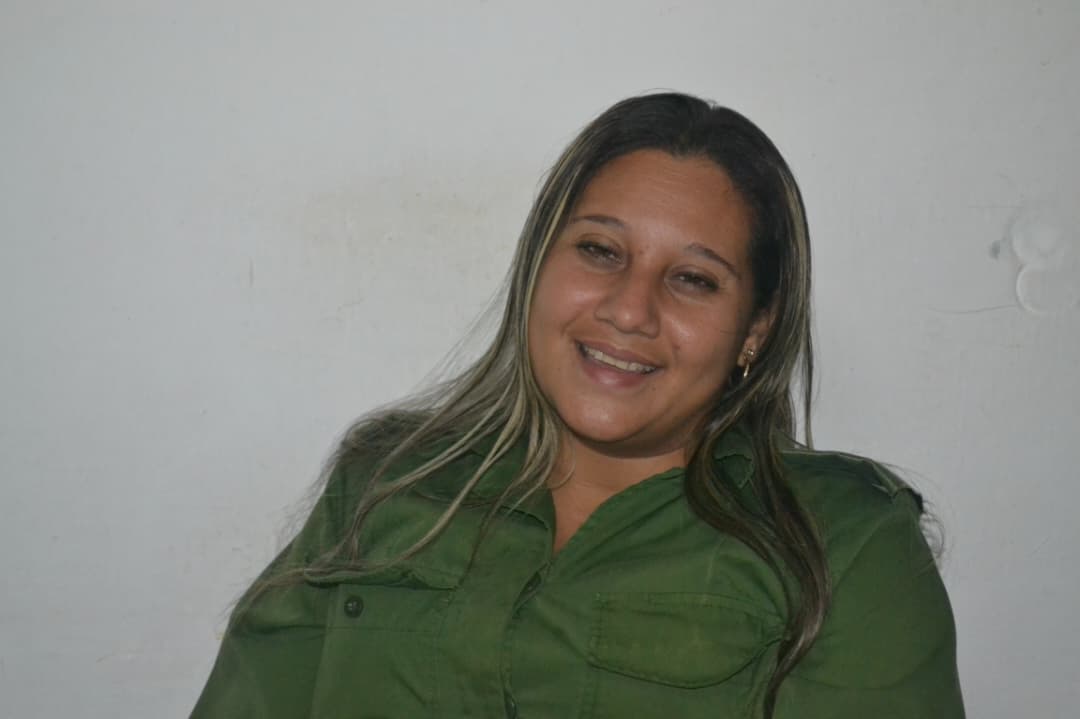
Dawn has barely broken when Dayana is already awake. In the silence of those early hours, when the rest of the city seems suspended between sleep and the first stirrings of the day, the routine of this 31-year-old member of the Revolutionary Armed Forces (FAR in Spanish) often begins.
Her story emerges in the context of International Women's Day, a date that invites us to consider the diverse paths women have chosen to build their lives. In Dayana's case, the military uniform has, for years, become the expression of a commitment that transcends the workplace.
Talking to her is to encounter a woman who has learned to move with ease in an environment that, for a long time, was dominated almost exclusively by men. Her tone is serene, yet firm, as if the discipline that defines her daily routine were also present in her words.
From a very young age, she felt a curiosity for military life. While many people envisioned other paths for their future, she discovered in that world a blend of order, responsibility, and a sense of belonging that she found deeply appealing.
The moment she decided to take that step remains vivid in her memory.
“Many thought it was crazy,” she recalls with a serene smile. “Some people told me that wasn’t a job for a woman, that it would be too hard. But I always felt that if something called to me, I had to try it. I couldn’t imagine remaining uncertain.”
That initial impulse eventually blossomed into a vocation. Life within the institution quickly taught her that the uniform represents much more than a professional identity. It embodies discipline, constant preparation, and the ability to respond to any circumstance.
Dayana explains that the military routine is unlike any other type of work. There are days when rest can be unexpectedly interrupted, moments when duty arises without warning and forces a reorganization of personal time.
For her, waking up before dawn ceased to be unusual long ago. “When you’re here, you understand that the commitment has no set hours,” she says.
“There are early mornings when the call comes, and you get up almost automatically. At first, it’s difficult, of course, but then it becomes part of your life. You know you’re fulfilling a responsibility.”
At 31, she acknowledges that the path has been fraught with challenges that aren’t always visible from the outside. The physical training, technical preparation, and demands of the military environment require perseverance and mental fortitude.
However, one of the most complex challenges has been confronting the prejudices that persist in some sectors of society.
On more than one occasion, she has had to listen to comments questioning the presence of women in traditionally male-dominated spaces. Despite this, Dayana learned to transform those doubts into motivation.
“At first, it hurts a little when someone doubts you just for being a woman,” she admits. “But over time, I learned that the best response is to do your job well. When people see your effort and your responsibility, they often change the way they see you.”
Life within the FAR (Revolutionary Armed Forces) has also gifted her with human experiences she considers fundamental. Daily coexistence creates bonds that go beyond the professional relationship.
As she explains, mutual trust is indispensable in that environment. Knowing that the people you work alongside share the same sense of responsibility strengthens team spirit.
"You learn that no one is alone here," she affirms. "Discipline is important, but so is camaraderie. There are difficult moments, and knowing you have someone by your side who trusts you makes a big difference."
Her personal history doesn't yet include children or a family of her own. However, Dayana doesn't consider that absence to define her feminine identity. For her, femininity isn't limited to a single lifestyle.
"Being a woman doesn't necessarily mean following the same path as others," she reflects. "There are women who decide to become mothers very young, others who dedicate themselves to studying, starting businesses, or doing research. I found my path here. And that, too, is a form of fulfillment." Talking about her work fills her with pride, though she avoids grandiloquence. She prefers to describe it as a responsibility she takes seriously, aware that the service involves personal sacrifices.
There are long days, demanding training, and times when her personal life must adapt to the demands of her job. Even so, she doesn't feel she's lost anything essential. “Everything has a price,” she says matter-of-factly. “But when you believe in what you do, that sacrifice becomes more bearable. I feel like I’m contributing something, and that gives me peace of mind.”
Outside of her uniform, Dayana maintains personal interests and spaces that allow her to balance her life. She enjoys time with her family, conversations with friends, and those simple moments that help her disconnect from the intensity of her work.
Even so, she acknowledges that the institution is an essential part of her identity. When she looks back, she’s surprised by the amount of experience she’s accumulated in just over a decade of service. The young woman who once joined with curiosity and expectations has become a woman aware of the responsibility that comes with her choice.
“This job has taught me to trust myself more,” she explains. “Sometimes you don’t know what you’re capable of until you face situations that test you.”
On dates like International Women’s Day, her story takes on a particular meaning. Not because she considers herself different from other women, but because she represents one of the many ways women contribute to society.
 Dayana believes that women's progress is reflected precisely in this diversity of paths.
"The most important thing is that a woman can choose," she affirms. "That she has the freedom to decide what she wants to do with her life. That is true progress."
As she speaks, her demeanor conveys serenity. There is no drama in her story, but rather a quiet conviction that seems to have been built over the years.
Perhaps that is why her story is so significant. It is not about an extraordinary feat or an isolated heroic gesture, but rather the sum of many everyday decisions: getting up early when duty calls, training with discipline, facing prejudice, and remaining steadfast in a vocation.
At the end of the conversation, when asked what it means for her to be a woman in a military environment, Dayana is silent for a few seconds before answering.
"It means demonstrating that strength can also have sensitivity; that we can be disciplined, responsible, and strong without ceasing to be who we are."