


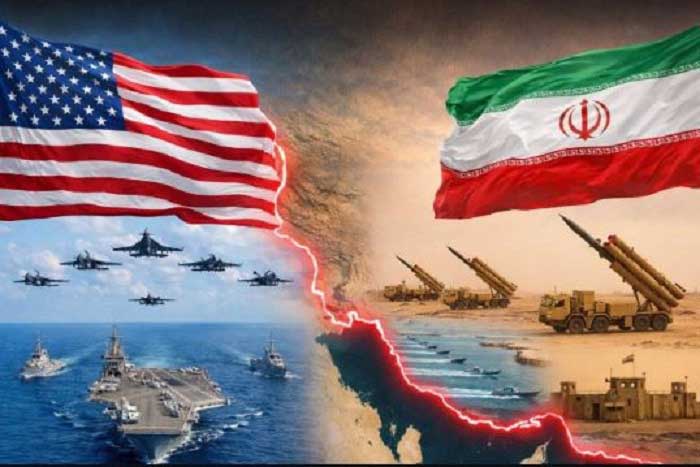
Trump has just accused NATO of cowardice for not getting more involved in the Iran war. The allies' military bases, especially British ones, have been available to the Pentagon almost since the beginning of hostilities, but what the president is asking for goes beyond that. He wants the Persian Gulf, closed by the Iranians, to be opened by all Western nations, making his allies pay for the mistakes the American president himself made. The first mistake was getting involved in a war he cannot win, or will not win easily, without a cost that could be far greater than Iraq's. The equation is simple: Tehran only sanctioned the United States and Israel by preventing ships from passing through the Strait of Hormuz.
Through this pressure, Trump wants the entire West to be affected and, in doing so, seeks collective blame for the inflationary disaster resulting from his decisions. This would somewhat salvage his image with the electorate, who see this war as a desperate exercise of power that does nothing to benefit the public.
But there's more. If the West becomes collectively involved, then American casualties in a ground invasion could be lower. The burden shared with allies would lend international legitimacy to the action, and the president could present the war as a transatlantic security matter or a genuine national security issue supported by strategic allies. The truth is that, at the very moment this analysis is being written, Iran has launched a long-range missile that impacted British territory in the Indian Ocean, demonstrating Tehran's medium- and long-range military capabilities.
Europe trembles at the prospect of facing a military threat of this magnitude, and the conflict escalates further toward a global confrontation between superpowers. The folly of resolving differences through armed conflict has perhaps led the West to a point of no return, the outcome of which is uncertain. They have engaged in geopolitics without holding all the cards in their favor, beyond record military expenditure, on which they confidently believed they could rely as an advantage.
The war has further fractured Western unity as Europeans have hesitated in the face of the folly of this decision. It’s known that they will be affected by something that does not benefit them, because it’s a cause long pursued and cherished by the Netanyahu government and its hardline faction within the conservative government in Tel Aviv. It’s a war with a millennial projection, based on an expansive ideological foundation on behalf of Israel.
Both white Christian Zionists in the United States and Israelis are convinced that they are hastening Armageddon and the arrival of the Messiah. Here, a distinction must be made because ideological visions intertwine with material desires, forming a web of real interests. In reality, the State of Israel needs this type of confrontation as existential fuel, which is why they have drawn the West into it.
The cost to humanity is high and could be worse. The benefit so far is absurd: an American army forced to abandon forward positions in the Gulf, ships sunk with oil cargoes, rising prices, and insecurity for the Arab financial centers of the region. Nothing about Trump's decisions seems rational, coherent, or sound.
But the biggest loser in this war is NATO. It not only emerges weakened, but it has also lost its ability to provide a coherent response internally. Trump has worn it down with demands, questions, and existential critiques. It no longer displays its former strength, and this suits rival powers that watch silently, providing intelligence to Iran and waiting for their opportunity.
The war is burying the remaining pockets of power and alliances held by the United States and will leave the empire more isolated when Trump's term ends. In this geopolitical game, both Russia and China have been considering a new scenario in which Europe must once again align itself with Moscow and Beijing due to their economic influence.
NATO has tried to survive Trump, but its member countries are already seeking alliances with external powers, as is the case with... Southern European countries like Spain, which, while refusing to increase military spending, maintain quite strong trade ties with China. Or, as is happening with Hungary, which, through its president Orbán, refuses to join the absurd anti-Russian fraternity of the Western world, due to its dependence on Eastern hydrocarbons.
The chessboard is shifting, even though the demagogues continue to listen to Trump and believe that Anglo-Saxon power has been restored through these displays of force. In reality, everything that’s happening leads to a major questioning of the United States' role in the future and to the emergence of new, more realistic and functional power structures outside the world created after World War II. The breakdown of the international order gives way to another order in which the real economy and the bonds born from that process prevail.
How does this look in practice? Iran is demanding the sale of Persian Gulf oil in Chinese yuan, which constitutes an act of war and a devastating blow to the financial power of the United States. This forces the Americans to print more unbacked currency, increasing the country's debt and pushing it toward bankruptcy. The currency transition, moreover, is accelerating as transactions in yuan increase, thus boosting reserves in that currency for one of the world's driving sectors: energy.
If this war does not end soon with an agreement allowing the Gulf monarchies to export oil in dollars, the impact of this conflict on the immediate economic future of the United States will be devastating, and it will not be recoverable even with changes in policy or a new president. The decision to initiate a war in the heart of the oil industry has been an unprecedented blunder for an inexperienced politician, acting outside the bounds of rationality and realism in international relations.
American hegemony is also the perception of that hegemony. If an invasion doesn't occur in the coming months (with the costs that entail), the media will no longer be able to mask the West's defeat. It will be a point of no return in terms of building an image of power. If, on the other hand, they advance with ground troops, there’s also a high probability of defeat or a significant loss of life, which in liberal democracies translates into electoral disaster for any political party. The equation is lose/lose, and analysts know it; the advisors who got Trump into this didn't properly consider the outcome.
It remains to be seen whether, in the short term, Iran will propose an agreement and whether the international treaty system (the other big loser in this war) has enough credibility to maintain a ceasefire. (CubaSí)