












• The Heart Behind “Ismaelillo”

    The Heart Behind “Ismaelillo”

  • Shaka: 18% Alcohol that Goes Unnoticed

    Shaka: 18% Alcohol that Goes Unnoticed

  • More Than 30 Years of Dedication

    More Than 30 Years of Dedication

  • Norge, the Nurse Who Listens to Babies

    Norge, the Nurse Who Listens to Babies

  • Concert Music, Culture, and a City Awaking (+photos)

    Concert Music, Culture, and a City Awaking (+photos)

Las Tunas News

POS Terminals at Las Tunas Electric Comp…

Since August, the Buena Vista sales office, part of the Las Tunas Electric Company, has become the first in the municipality to implement the Point-of-Sale (POS) terminal as a payment...

Transportation in the Province Collabora…

The transportation sector is undergoing a transformation intended to revive public passenger services through collaboration with non-state management models.

Return Prosperity to Cubans

Vice Prime Minister Jorge Luis Tapia Fonseca held a fruitful and enlightening exchange with Las Tunas authorities and representatives of the agricultural system on the implementation of the 176 economic...

“My Neighborhood for the Homeland” I…

Amid the energy shortcomings and economic challenges the country is facing, Constituency 56, “El Tejar,” part of the Las Parras People’s Council, has become a model of popular participation.

National Union of Jurists of Cuba Streng…

The board of directors of the National Union of Jurists of Cuba (UNJC) met in Las Tunas to strengthen the board and all grassroots structures, as well as to conduct an...

Las Tunas Strengthens Avenues for Cooper…

The Business and Opportunities Fair —an event marking the provincial capital's 230th anniversary that seeks to strengthen ties between economic entities, promote services, and foster commercial alliances within the province—...

We Recommend

Cuba News

Fernández de Cossío: U.S. Blockade Cau…

Cuban Deputy Foreign Minister Carlos Fernández de Cossío has reiterated that the intensification of the United States blockade is aimed at inflicting severe harm on the island’s population.

Cuban President Reaffirms Priority of De…

President Miguel Díaz-Canel led National Defense Day activities on Friday at the Rampa Defense Zone, located in the Plaza de la Revolución municipality, where he reaffirmed that defense preparedness is...

Cuba Denounces Multidimensional Aggressi…

Cuban Foreign Minister Bruno Rodríguez Parrilla denounced at the UN on Saturday that his country is facing a multidimensional aggression by the United States government, a permanent, abusive, and ruthless...

Havana International Fair Returns in lat…

The 42nd edition of the Havana International Fair (FIHAV) will take place virtually from November 24th to 26th via the URL www.cuba.feriahabana.cu, the official platform launched by its Organizing Committee announced.

The Persecution of Cuban Medical Mission…

A fact has been revealed about Cuba that strikes anyone with the most basic sense of humanity: The infant mortality rate on the island rose from 4.0 per 1,000 live...

Statement by the Ministry of Foreign Aff…

The Ministry of Foreign Affairs of Cuba learned on Friday, September 18, through the press, of the surprising statement made by the Costa Rican Foreign Minister, Manuel Tovar Rivera, to...

World News

Features

In the confrontation with the undesirable bush, numerous resources are invested

In the last 150 years, the marabou (Dichrostachys cinerea) has become the plant that has proliferated the most in Cuba, a fact that worries a lot and should almost shame us, because that invasive exotic species has taken over large and important areas of land, such as the agricultural belt of the provinces of Ciego de Ávila, Camagüey and Las Tunas.

Las Tunas, Cuba.- Many things happened in all that time, from lack of motivation to indifference, which overshadowed the interest of a few; in many places, it grew without limits of space, even along the roads and railways.

Today it is part of the panorama that is observed as people move from one place to another and within the landscape, there is more marabou, much more.

Exactly, in the territory of Las Tunas, this weed infests, to different degrees, thousands of hectares in areas of the eight municipalities, where it prevents better results in important activities such as various crops and livestock; therefore, it is the specimen of the flora that has caused the most damage to the socio-economic development of the region.

In the first place, the plant has characteristics that make it superior to the others in terms of resistance to drought, pests and diseases; likewise, it easily adapts to all types of soils, which is favorable, taking into account that in Las Tunas more than 80 percent of these are affected.

Within the country's landscape, there is too much marabouIts damages are specified in the displacement of other plant species and their multiplication in clean lands through the feces of cattle, which eat the seeds and deposit them in germination conditions.

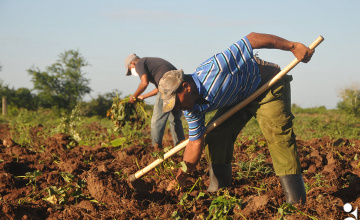
In the confrontation with the undesirable bush, numerous resources are invested such as files, machetes, axes and chemical products when there are them. Also significant is the effort of those who remove this vegetation to transform the environment and give a new opportunity to what is most needed in the current circumstances: food production.

Fortunately, the situation looks set to change, for the better. In the battle against the marabou, various organizations and entities of Las Tunas intervene, such as the Credit and Commerce Bank, with tempting loans; the Provincial Delegation of the Ministry of Science, Technology and Environment, which insists on control, not on the elimination all of a sudden. In other words, reduce populations and prevent their reproduction by the immediate use of the already clean areas.

In defense of the plant, it can be argued that it favors the production of excellent quality charcoal, preferred in several European nations, which has brought good dividends to the territory. But it hurts more than it benefits.

The municipality of Las Tunas has been an example in such a struggle. There are the results in the Techo Rojo, Majagual and La Salida farms, and there is the creative spirit with the operation of a mowing machine on a tractor with iron wheels, in addition to the use of heavy machinery to clear the bush.

In short, the marabou must be faced head-on, as some peasants say, and without fear. That is the only option to end a plant epidemic that hurts and undermines our true possibilities.