



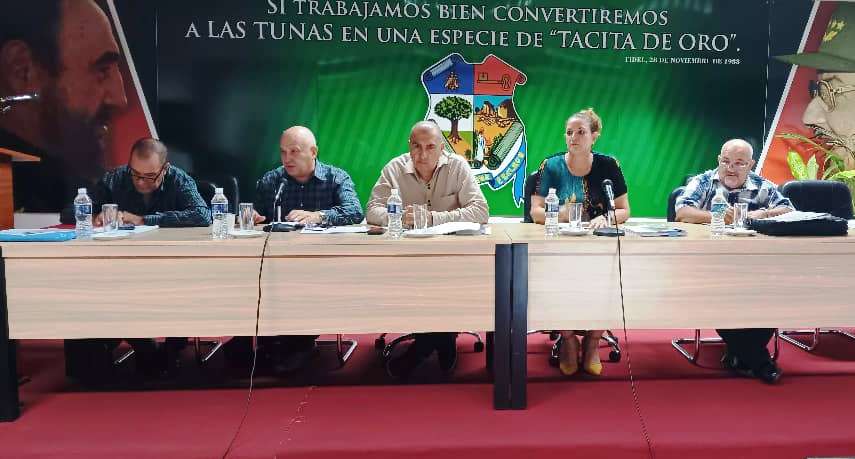
Vice Prime Minister Jorge Luis Tapia Fonseca held a fruitful and enlightening exchange with Las Tunas authorities and representatives of the agricultural system on the implementation of the 176 economic and social transformations of Cuba’s Government Program for 2026.
Las Tunas, Cuba.- The reflections revolved around thematic axis seven, referring to the transformations approved to encourage the country's agricultural recovery, with emphasis on the Land Law and the autonomy it grants, and the Cooperative Law, two tools backing the legal support for its implementation in Cuban fields.
Tapia Fonseca insisted on the need to study these legal provisions and master them in detail as guarantors of results that change the nation's rural life, attract investments, projects, workforce... and result in more food for the people.
He exalted the autonomy provided by the new legal provisions and called for taking advantage of them for the benefit of production and the well-being of the men and women who work the land to obtain greater wealth.
In his repeated interventions, he emphasized issues related to the marketing of agricultural production, contracting, and especially meat and milk, foodstuffs of high popular demand with very sensitive social destinations, input markets, and financial activity.
The deputy prime minister demanded to ensure that acting in accordance with the law does not lead to slowness and "hassle" in the procedures due to the expectations of the interested parties to join the exploitation of the land.
Meanwhile, Ydael Jesús Pérez Brito, Minister of Agriculture, recalled that the transformations were approved to change the situation the sector is going through, and called for properly implementing them with the speediness that these times demand.
TRAINING
“If we do not prioritize the field, there is no transformation,” emphasized Tapia Fonseca, and highlighted, as a priority, gaining the legal culture that the moment demands. “We have never worked with so many laws in such a short time,” he emphasized, and highlighted that they provide answers to many of the concerns the peasantry expressed in their congresses.
He stressed that the training of cadres in the legal order is essential, and called for strengthening this activity in the entities, creating technical tables for debate, and designing -from the Government -an instruction process that allows them to reach the 290 agricultural production cooperatives, the more than 24 thousand usufructuaries and the more than eight thousand owners, in short, all the territory’s agrarian communities.
The meeting was attended by the highest authorities of the Cuban Communist Party (PCC) and the Government in the province, and representatives of the country's legal and banking institutions capable of accompanying the implementation of the transformations.