

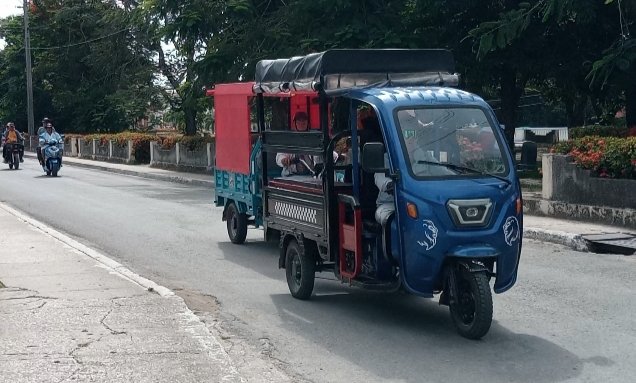
Within the framework of the 176 economic and social transformations that govern the country’s economic policy, the Las Tunas transport sector has adopted a diversification strategy aimed at restoring productive capacity and human capital. However, its implementation has seen both successes and shortcomings.
Las Tunas, Cuba.- One of the most advanced initiatives is being led by the provincial enterprise Cardinal. The entity has already entered into an agreement to establish a solar-powered refueling station at the Railway Terminal, a project intended to help restore the facility too. Authorities have clarified that the terminal will continue its usual services, and that a second phase of the project will include the renovation of the administrative offices.
Meanwhile, the School Transport Enterprise (Empresa de Transporte Escolar) aims to transition into a state-owned MSME (micro, small, or medium-sized enterprise). The goal is to broaden its range of services to include offerings such as parking facilities, a vehicle-washing station, and machine shop (lathe) services. This transformation is intended not only to achieve financial self-sufficiency but also to provide services to the local community and other organizations.
The Las Tunas Taxi Agency presents a mixed picture. On one hand, it has become a national benchmark by leasing out its headquarters, which now houses the MSME "TecSolucion." On the other hand, the transport of foreign visitors —the agency’s core mandate— remains at zero. Consequently, the agency has been forced to reinvent itself by offering services to residents who wish to hire its taxis.
The port sector has reported encouraging figures. The Carúpano Port Terminal (Terminal Portuaria Carúpano S.A.), operational since January, has generated over twenty million in earnings, with sales reaching 200 percent of targets. Of the 15,000 tons of cargo handled, 9,000 passed through this port. Nevertheless, the workforce situation warrants deeper attention.
However, this strategy's success depends not only on the agreements signed, but on the ability to manage talent and resources, monitor ongoing projects, and correct any deviations that may arise.